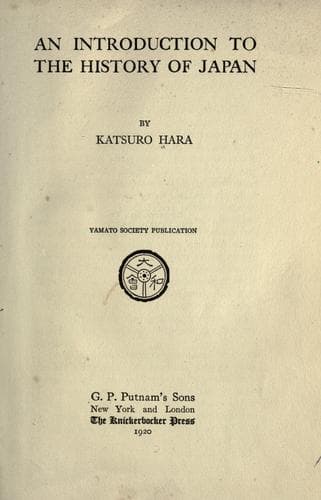
An Introduction to the History of Japan — John Shaqi
An Introduction to the History of JapanHara, Katsuro
History
An Introduction to the History of Japan
Hara, Katsuro
Japan -- History
The last item we must mention here is the _misogi_. The _misogi_ is an
old religious custom of lustration by bathing in cold water. In a legend
of our mythical age, there is an account of this antique ritual
performed by two ancestral deities in a river in Kyushu, and this ritual
has come down to our day, of course with some modifications. The custom
of actually bathing in the water was afterward superseded by the
throwing of effigies into a river, in the annual ceremony of praying
publicly to deities. In medieval Japan this usage continued to be
practised at a riverside in the summer; but it is almost extinct
nowadays. On the other hand, not as a public ceremony, but as a method
of individual self-purification, this custom of lustration is still
practised by many pious persons. Almost entirely naked, even in the
winter of northern Japan, they pour on themselves several bucketfuls of
cold water, and thus purify themselves from head to foot, in order to
attest a very special devotion to the deities to whom they pray. This
custom of bathing with its religious signification is something that
cannot find its likeness anywhere else, either in northeastern Asia, or
in China, or in Korea. Whence, then, did the ancient Japanese get this
unique custom? Would it not be natural to suppose the custom of bathing,
including its religious use, to have originated in some quarter of the
torrid regions of the earth than to speak of it as initiated in the
frigid zone?
All the four items mentioned above ought by all means to be interpreted
adequately and naturally, whatever standpoint one may take in solving
ethnological questions concerning the Japanese. The hypothesis that the
bulk of our forefathers might have been immigrants from northeastern
Asia, is, as already said before, by itself nothing but an assertion,
supported mainly by the form of certain prehistoric pottery, which may
possibly be interpreted otherwise, perhaps disadvantageously, too, for
the assertion. We may accept the hypothesis as probable, taking into
consideration the proximity of the supposed home of our ancestors to
Japan. But it avails us not at all in interpreting the points which I
have enumerated above. On the contrary, if we concur with the
supposition that the ruling class, also, of the Japanese has its
original home in the northeastern part of the Asiatic continent like the
bulk of the race, then the interpretation of the aforesaid items would
become more difficult. It is true that those who would like to derive
the origin of the Japanese from northeastern Asia, do not absolutely
deny the existence of a certain tropical element in the final formation
of the Japanese race, but generally they think that the element must
have been very insignificant. They would never go so far as to look to
the element for the bulk of our forefathers or for the ancestors of the
ruling class. If the tropical element be as insignificant as they
Public-domain text, read in full here on John Shaqi.
Reviews
Reviews
No reviews yet
Be the first to share your thoughts on this work.
Join the Discussion
Join the discussion
Sign in to leave a comment or review.
Sign InorCreate an account