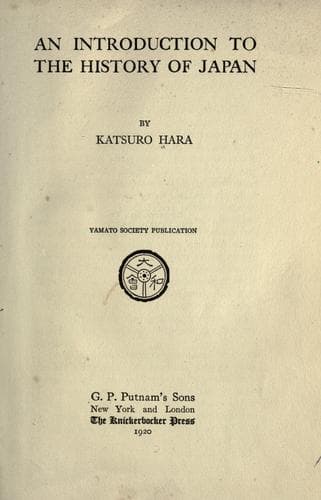
An Introduction to the History of Japan — John Shaqi
An Introduction to the History of JapanHara, Katsuro
History
An Introduction to the History of Japan
Hara, Katsuro
Japan -- History
Before entering into a description of the early history of Japan, it may
be of some service to the foreign reader to learn when the authentic
history of Japan begins. Generally it is not an easy matter to draw a
distinct line of demarcation between the historic and the prehistoric
age in the history of any country, and in order to get rid of this
difficulty, an intermediate age called the proto-historic was invented
by modern scholars, and has been in vogue up to now. It is true that, by
making use of this term, one aim was surely attained, but two
difficulties were thereby created in lieu of one dismissed. We were
freed, indeed from the hard task of making a delicate discrimination
between the historic and the prehistoric age, but at the same time we
took up the burden of distinguishing the proto-historic age from both
the historic and the prehistoric! And these new difficulties cannot be
said to be easier to meet than the old, so that it may be doubted
whether it was wise to intercalate the proto-historic age between the
two, if the promotion of scientific exactitude was the main purpose of
such an intercalation. A polygon, however the number of its sides be
augmented, can never make a circle in the exact sense. I shall not,
therefore, try to adhere scrupulously to the above-mentioned threefold
division in discharging the task which I have undertaken.
Let me turn then to the line of demarcation between the historic and the
prehistoric age without troubling myself about the proto-historic. This
line must be drawn by first making clear the signification of the
historic age, and not by defining the term "prehistoric." What, then is
the historic age? It may be defined as an age, the authentic history of
which can, in a large measure, be ascertained, or as an age which has an
historical record, contemporary and fairly reliable. It is to be
regretted that we cannot dispense with such precautionary expressions as
'to a large measure' and 'fairly', but we cannot avoid retaining them,
and therein lies the true difficulty of making an exact demarcation.
Moreover, an age, the history of which was regarded at one time as
impossible of being ascertained, often may become ascertainable as the
result of ever-increasing discoveries of new materials as well as of the
new methods of their deciphering. In other words, the demarcation,
however conscientiously made at one time, is liable to be shifting, and
the reason for the demarcation gradually changes _pari passu_. As the
word prehistoric has now begun to be used independently of 'historic',
the historic age may be better defined as an age which has a
civilisation advanced enough to have a record of its own. So far a
country may be said to be in an historic age, even at an epoch the
historical sources of which are considered not to be extant anywhere,
only if the standard of civilisation be high enough for that. Unless we
adopt this definition, the line of demarcation may shift more and more
Public-domain text, read in full here on John Shaqi.
Reviews
Reviews
No reviews yet
Be the first to share your thoughts on this work.
Join the Discussion
Join the discussion
Sign in to leave a comment or review.
Sign InorCreate an account