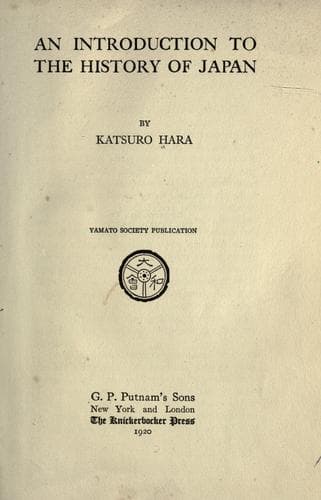
An Introduction to the History of JapanHara, Katsuro
History
An Introduction to the History of Japan
Hara, Katsuro
Japan -- History
Japan stood on the verge of a crisis, and it was saved from catastrophe
by two causes. First, by the ceaseless importation of high Chinese
civilisation, which steadily encouraged the political concentration;
secondly, by the necessity of centralisation so as to push on vigorously
the attack on the still powerful Ainu.
As I have mentioned several times before, the Ainu had been a losing
party in the racial struggle with the Japanese, yet their resistance had
been a very stubborn one, so that at the end of the sixth century they
could still hold their ground against the Japanese on the southern
boundary of the present provinces of Iwaki and Iwashiro, which roughly
corresponds to latitude 37 deg. N. The northern part of Japan, therefore,
was still in constant danger of incursions by the hairy race. For a
country in the infant stage of consolidation, as Japan was at that time,
it was by no means an easy task to ward off the frequent inroads of that
race, and at the same time to continue the process of the inner
organisation of the state. One would perhaps wonder at my conclusion,
starting from the consideration that the Ainu scare was not such a
fearful thing as to influence the natural growth of a state formed by
the stronger race. This misconception arises from the ignorance of the
fact that the famous dictum "delenda est Carthago" was only pronounced
after the first Punic war. Necessity by itself does not create the
desire to secure what is necessary. The desire to attain any aim first
comes into consciousness when one begins to feel strong enough to
venture to attain it. When the Ainu was very powerful, the Japanese had
to contend with them mainly in order to secure a foothold against them.
It was none the less necessary for the Japanese to continue to struggle
with the Ainu, when the former became strong enough to face the
antagonist evenhanded. Lastly, the time arrived now when it became an
urgent necessity for the Japanese to crush the Ainu, in order to achieve
undisturbed a full political organisation in the domain within the four
seas. In short, when the Japanese became so convinced of their might
that they could not tolerate any rival within the principal islands,
they found it even more indispensable to organise themselves as
compactly as possible under one strong supreme head than ever before.
Public-domain text, read in full here on John Shaqi.
Reviews
Reviews
No reviews yet
Be the first to share your thoughts on this work.
Elsewhere in the archive
Join the Discussion
Join the discussion
Sign in to leave a comment or review.
Sign InorCreate an account