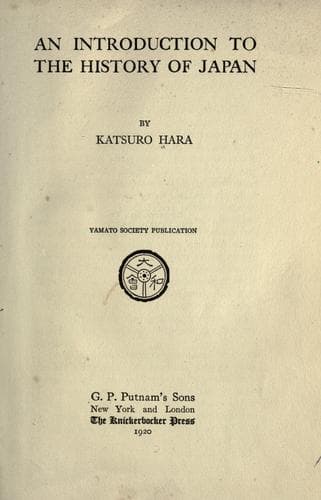
An Introduction to the History of JapanHara, Katsuro
History
An Introduction to the History of Japan
Hara, Katsuro
Japan -- History
What most facilitated the centralisation under the imperial rule was of
course the imported Chinese civilisation. To say sooth, several
centuries of the slow infiltration of that high civilisation had already
attained a great deal of influence, but it was rather a smuggled, and
not a really legalised importation. Moreover, China herself, the source
from which the civilisation had to be imported, had been dismembered for
a long time, so that until 581 A.D. the country could hardly be called a
unified state at all. How could we expect to find in a country where no
order ruled a model suitable to be employed as exemplar to effect a
durable political reform. It is not strange, therefore, that,
notwithstanding the long years of intercourse between the two countries,
only a very slight change had been thereby occasioned in our country as
regards our political organisation. Any change which was wrought in our
political sphere by Chinese influence was effected in a very indirect
way, having worked its way through multifarious social changes caused by
the contact with the high alien civilisation. No direct political clue
could be followed up from China to this country. To achieve the purpose
of borrowing from China the necessary materials for the reconstruction
of political Japan, we had to wait longer, that is to say, till the
inauguration of regular intercourse between this country and China also
politically unified and concentrated.
That memorable year came at last. In 607 A.D. Ono-no-Imoko was
despatched as official envoy to China, which at that time was under the
second emperor of the dynasty of Sui. Even before this date, however,
since the accession of the Empress Suiko, as the result of the busy
intercourse between us and the peninsular states, various arts and
useful sciences of Chinese origin had been introduced into this country,
among which astronomy, the oldest perhaps of all sciences everywhere in
the world, was the most noteworthy. Connected with this science, the art
of calendar-making was introduced for the first time into Japan. It
would be a gross mistake, if we thereby conclude that we had no means of
defining the dates of events prior to this introduction. Although we
could not by ourselves make an independent calendarial system, yet the
Japanese, at least the naturalised scribes, had already been acquainted
with two chronological methods. The one was to define a date by counting
from the year of the accession of a reigning emperor. The other method
was that which had prevailed long since in China, that is to say, to
define a date by counting according to the cyclical order of the twelve
zodiacal signs, interlaced with the cyclical order of ten attributes, so
that to complete one cycle sixty years were necessary. Some groups of
scribes, perhaps, pursued the former method, while others favoured the
latter. Contradictory statements and evident repetitions abundantly
found in the _Nihongi_ were thus occasioned by the existence of
Public-domain text, read in full here on John Shaqi.
Reviews
Reviews
No reviews yet
Be the first to share your thoughts on this work.
Elsewhere in the archive
Join the Discussion
Join the discussion
Sign in to leave a comment or review.
Sign InorCreate an account