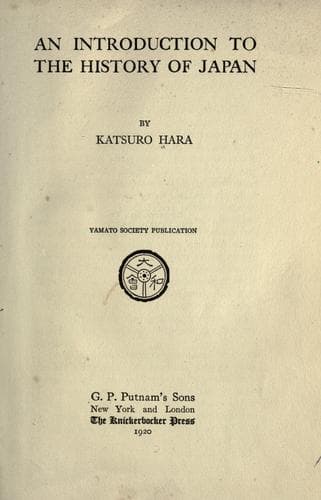
An Introduction to the History of JapanHara, Katsuro
History
An Introduction to the History of Japan
Hara, Katsuro
Japan -- History
In lands thus made public, provinces were established, and governors
were appointed. Under those governors served the former local lords and
group-chieftains as secretaries of various official grades or as
district governors, all salaried, paid in natural products, of course,
since no currency existed at that time. In every province, a census was
ordered to be taken, and arable lands were distributed according to the
number of persons in a family, with variations with respect to their
ages and sexes. The distribution had to be renewed after the lapse of a
certain number of years, paralleled to the renewal of the census. The
tax in rice was to be levied commensurate with the area of the lot of
land distributed. Additional taxes in silk, flax, or cotton were to be
paid both per family and according to the area of the distributed lot.
Corvee was also imposed, and any one who did not serve in person was
obliged to pay, in rice and textiles for a substitute. Besides these
imposts, there were many circumstantial regulations concerning the
tribute in horses, equipment of soldiers, use of post-horses, interment
of the dead of various ranks, and so forth. These laws and regulations
taken together are called the Ohmi laws, from the name of the province
into which the Emperor Tenchi had removed his residence.
For three-score years after the promulgation of the reform of Taikwa,
there were many fluctuations, sometimes reactionary and sometimes
progressive, and many additions and amendments were made to the first
enactments published. In general, however, they remained unchanged, and
were at last systematized and codified in the second year of the era of
Taiho, that is to say, in 702 A.D. This is what the Japanese historians
designate by the name of the Tai-ho Code.
After an impartial comparison of this code with the elaborate
legislation of the T'ang dynasty, one cannot deny that the former was
mainly a minute imitation of the latter. Preambles and epilogues issued
at the time of the first proclamation were taken from passages of the
Chinese classics, and there are many phrases in the text itself which
plainly betray their Chinese origin. Many regulations were inserted, not
on account of their necessity in this country, but only because they
were found in the legislation of the T'ang dynasty.
Public-domain text, read in full here on John Shaqi.
Reviews
Reviews
No reviews yet
Be the first to share your thoughts on this work.
Elsewhere in the archive
Join the Discussion
Join the discussion
Sign in to leave a comment or review.
Sign InorCreate an account