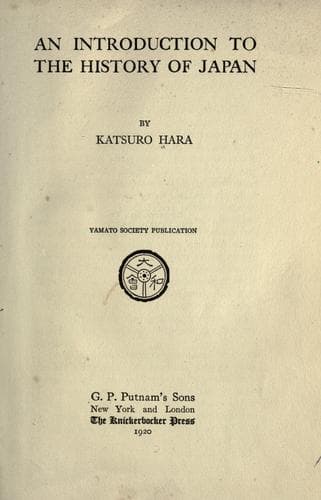
An Introduction to the History of JapanHara, Katsuro
History
An Introduction to the History of Japan
Hara, Katsuro
Japan -- History
There are of course not a few modifications, which can be discerned when
carefully scrutinised, and these modifications are generally to be found
in those Chinese laws which were impossible of introduction into our
country without change. Some of them, having been planned originally in
the largest Empire of the world and in an age as highly civilised as
that of the T'ang, were too grand in scale, so that they had to be
minimised in order to suit the condition of the island realm. Others had
too much of the racial traits of the Chinese to be put at once in
operation in a country such as Japan, which on its part had also sundry
peculiarities not to be easily displaced by legislation originated in an
alien soil. This was especially the case with respect to religious
matters. Though it is a question whether Shintoism may be called a
religion in the modern scientific sense, it cannot be disputed that it
has a strong religious element in it. On that account, it had proved a
great obstacle to the propagation of Buddhism, which was the religion
embraced at first not by the common people but by men belonging to the
upper classes, so that the latter, while earnestly encouraging the
inculcation of Buddhism, were obliged to show themselves not altogether
indifferent to the old deities. In behalf of the Shinto cult, special
dignitaries were appointed, the chief of whom played the same part as
the Pontifex Maximus of ancient Rome. Such an institution is purely
Japanese and was not to be found in the Chinese model. Apart from these
exceptions, however, the reform of the Tai-kwa era was essentially a
Japanese imitation of a Chinese original.
What was the result, then, of the reform undertaken partly from national
necessity, but partly also from love of imitation? Let me begin with the
bright side first.
Public-domain text, read in full here on John Shaqi.
Reviews
Reviews
No reviews yet
Be the first to share your thoughts on this work.
Elsewhere in the archive
Join the Discussion
Join the discussion
Sign in to leave a comment or review.
Sign InorCreate an account