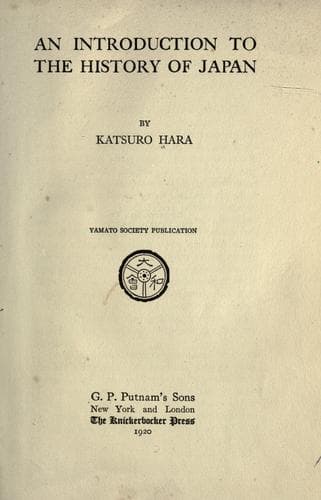
An Introduction to the History of JapanHara, Katsuro
History
An Introduction to the History of Japan
Hara, Katsuro
Japan -- History
Another remarkable event which contributed much to the remodelling of
the state was the total overthrow of the Japanese influence in the
Korean peninsula. About the middle of the sixth century Mimana was taken
by Shiragi, and with it our prestige in the peninsula suffered a severe
loss. Still for some time there remained to Japan a shadow of influence
in the existence of the state of Kutara, though the latter was very
unreliable as an ally. That state then began to be hard pressed by
Shiragi and asked for our help. More than once we sent reinforcements,
sometimes numbering more than twenty thousand soldiers. Arms and
provisions were also freely given. Owing to the incompetence of the
Japanese generals despatched, however, and the perfidious policy of
Kutara, our assistance proved ineffective. As a counter to our
assistance to Kutara, Shiragi invoked the aid of the T'ang dynasty,
which was eager to establish its rule over the peninsula. In the year
650 Kutara was at last destroyed by the co-operation of the army of
Shiragi and the navy of the T'ang. Next it was the turn of Kokuri to be
invaded by the T'ang army. A Japanese army consisting of more than ten
thousand men was sent in order to restore Kutara and to succour Kokuri.
In 663 a great naval battle was fought between the Chinese squadrons and
ours, ending in the defeat of the latter, for the former, consisting of
170 ships, far outnumbered the Japanese. With this defeat our hope of
the restoration of Kutara was finally lost. The remnants of the royal
family of Kutara and of the people of that state numbering more than
three thousand immigrated into Japan. Kokuri, too, surrendered soon
afterwards to the T'ang in 668, and long before this Shiragi had become
a tributary state of China. The influence of the T'ang dynasty prevailed
over the whole peninsula.
Since this time we were reduced to defending our interest, not on the
Korean peninsula, but by fortifying the islands of Tsushima and Iki and
the northern coast of Kyushu. There was no breach of the peace, however,
between Japan and China after the naval battle of the year 663, for
after the downfall of Kutara we had no imperative necessity to despatch
our army abroad, and therefore no occasion to come into collision with
the Chinese army in the peninsula. China, on her part, did not wish to
make us her enemy. The rough sea dividing the two countries made it a
very hazardous task to try to invade us, even for the emperors of the
Great T'ang. A Chinese general who had the duty of governing the former
dominion of Kutara sent embassies several times to Japan. At one time an
embassy was accompanied by two thousand soldiers as retinue, but the
purpose was plainly demonstrative. We also continued to send embassies
to China. Peace was thus restored on our western frontier, though under
conditions somewhat detrimental to our national honour.
Public-domain text, read in full here on John Shaqi.
Reviews
Reviews
No reviews yet
Be the first to share your thoughts on this work.
Elsewhere in the archive
Join the Discussion
Join the discussion
Sign in to leave a comment or review.
Sign InorCreate an account