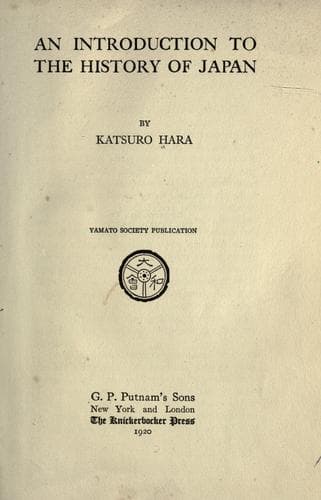
An Introduction to the History of JapanHara, Katsuro
History
An Introduction to the History of Japan
Hara, Katsuro
Japan -- History
Whatever be the intrinsic merit of the reform itself, there is no doubt
that the reform came from necessity. It was absolutely necessary that
Japan, in order to make solid progress, should be centralised
politically. The model which the reformers selected was the legislation
of a strongly centralised monarchy. In this respect at least it
admirably fitted the necessity of Japan at that time. In the year 659,
fifteen years after the promulgation of the reform, an organised
expedition consisting of a large number of squadrons, was despatched
along the coast of the Sea of Japan as far north as the island now
called by the name of Hokkaido. In the next year another expedition was
sent across the sea to the continental coast, perhaps to the region at
the mouth of the Amur. Though the frontier line on the main island was
not pushed forward against the Ainu so rapidly as the progress along the
western coast, owing to the obstinate resistance of the tribe on the
eastern coast, yet the victory was wholly on the side of the Japanese.
The removal of the imperial residence by the Emperor Tenchi in the year
667 to the side of lake Biwa, in the province of Ohmi, marks an epoch in
the progress of the exploration north-easternward. For the new site, a
little distant from the modern town of Ohtsu, is more conveniently
situated than the former residences, not only in guarding and pushing
the north-eastern frontier, but in keeping connection with the
navigation on the Sea of Japan. The inland lake of Biwa, though not
large in area, is one which must be counted as something in a country as
small as Japan. Until quite recent times, communication between Kyoto,
the former capital, and Hokkaido and the northern provinces of Hon-to
was maintained, not along the eastern or Pacific shore, but via the Lake
and the Sea of Japan. Even the eastern coast of the province of Mutsu
seems to have had no direct communication by sea with the centre of the
Empire. In order to reach there from the capital, men in old times were
obliged to take generally a long roundabout way along the western coast,
pass the Strait of Tsugaru, and then turn southward along the Pacific
coast. This important highway of the sea route of old Japan was
connected with Kyoto by the navigation across lake Biwa. The change of
the imperial residence to the neighborhood of Ohtsu, which is the key of
the lake navigation routes, had no doubt a great historic significance.
Public-domain text, read in full here on John Shaqi.
Reviews
Reviews
No reviews yet
Be the first to share your thoughts on this work.
Elsewhere in the archive
Join the Discussion
Join the discussion
Sign in to leave a comment or review.
Sign InorCreate an account