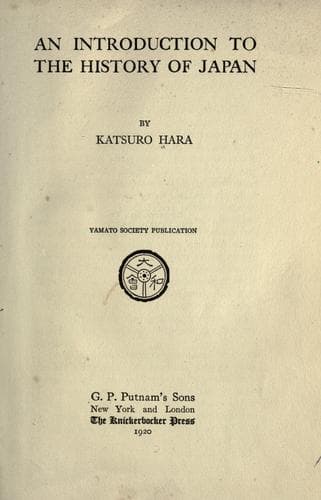
An Introduction to the History of JapanHara, Katsuro
History
An Introduction to the History of Japan
Hara, Katsuro
Japan -- History
The above remark is especially true as regards the military system. The
dynasty of the T'ang was in its beginning a strong military power. Its
military system was not bad, so long as it was worked by very strong
hands. On the whole, however, the political regime of the dynasty was
not such a one as to favour the keeping up of a martial spirit. After
the subjugation of the uncivilised tribes surrounding the empire, the
martial spirit of the Chinese nation soon relaxed, and the country fell
a prey to the invading barbarians whom the Chinese were accustomed to
despise. We find in it the exact counterpart of the Roman Empire
destroyed by the Germans. For the T'ang dynasty, it had been better to
conserve the military spirit a little longer in order to protect the
civilisation which it had brought to its zenith. With stronger reasons,
the need of a martial spirit ought to have been emphasised for Japan at
that time. The Japanese military ordinance of the reform was modelled
after the Chinese system, but of course on a smaller scale. The chief
fault, however, was its over-circumstantiality, being even more
circumstantial for Japan of that time than the original system was for
China herself. Before the reform we had several bands of professional
soldiers, which could be easily mobilised. That old system had gone. We
had still to fight constantly against the Ainu. Nay, the warfare on that
quarter was taken up with renewed activity, and we had to educate, to
train the people who were not at all accustomed to military discipline.
Having adopted a system resembling conscription, we were always in need
of an accurate census. To have an accurate census taken is a very
difficult matter even for a highly civilised nation. It must have been
especially so for Japan. In the reformed legislation the census was the
basis both for the military service and the land-distribution, taxation
connected with it. The land distribution system, though there might have
been some like element in the original custom of Japan, was yet on the
whole another Chinese institution imitated, very circumstantially again.
Moreover, though this reform seems to have been enforced throughout all
the provinces at once, except the southernmost two, Ohsumi and Satsuma,
in most of the provinces the part of the arable land brought under the
new system must have been very limited. Perhaps only such land in the
neighborhood of each provincial capital might have been distributed
regularly. Added to that, the growth of the population and the increase
of arable land necessitated a change in the distribution, and in the
said legislation a redistribution every six years was provided for that
change. In order to carry out this redistribution regularly and
adequately a very strong government and wise management were needed.
Otherwise either the system would be frustrated, or there would be no
improvement of land.
Public-domain text, read in full here on John Shaqi.
Reviews
Reviews
No reviews yet
Be the first to share your thoughts on this work.
Elsewhere in the archive
Join the Discussion
Join the discussion
Sign in to leave a comment or review.
Sign InorCreate an account