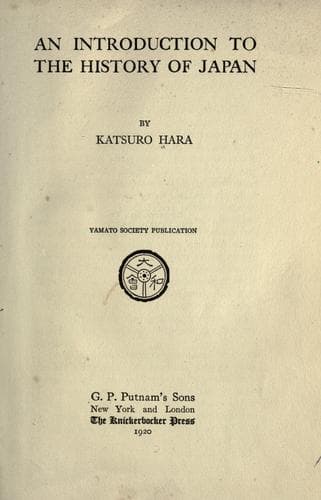
An Introduction to the History of JapanHara, Katsuro
History
An Introduction to the History of Japan
Hara, Katsuro
Japan -- History
Considered from the side of the people, the new legislation was not
welcomed in all ways. New taxes are generally wont to be felt heavier
than the accustomed ones. Besides these fresh imposts, military service
was demanded, which was quite a novel thing to most of them. In fact,
their burden must have been pretty heavy, for they could not enjoy a
durable peace at all, on account of the interminable warfare against
the Ainu. Many began to lead a roaming life, others avoided legal
registration in order to escape from taxation and military service.
Before long the fundamental principle of the grand reform collapsed, and
a very expensive governmental system remained, which, too, gradually
became difficult to be kept up. A change of regime seemed unavoidable.
CHAPTER VI
CULMINATION OF THE NEW REGIME;
STAGNATION; RISE OF THE MILITARY REGIME
Whatever be the merit or the demerit of the reform of the Taikwa, it was
after all an honour to the Japanese nation that our ancestors ever
undertook this reform. Not only because they were able to provide
thereby for the needs of the state of that time, but because they were
bold enough, temerarious almost, to aspire to imitate the elaborate
system of the highly civilised T'ang. When an uncivilised people comes
into contact with one highly civilised, it is needless to say that the
former is generally induced to imitate the latter. This imitation is
sometimes of a low order, that is to say, it often verges on mimicry,
and not infrequently results in the dwindling of racial energy on the
part of the imitator. Very seldom does the imitation go so far as to
adopt the political institutions of the superior. If they, however, had
ventured impetuously to do so, the result would have been still worse,
while in the case of Japan as the imitator of China, it was quite
otherwise. At first sight, as China of the T'ang was so incomparably far
ahead of Japan of that time, it might seem rather foolish of our
forefathers to try straightway to imitate her. Moreover, on the whole,
the imitation ended in a failure indeed, as should have been expected.
But the original institutions of the T'ang itself proved a failure in
their own home; hence, had the imitation of those institutions resulted
in a success with us, it would have aroused a great astonishment. The
very fact that our forefathers dared to imitate China, and did not
thereby end in losing spirit and energy, is in itself a great credit to
the reputation of the Japanese as a nation, for it testifies that they
have been from the first a very aspiring nation, unwitting how to shirk
a difficulty. If it be an honour to the Germans not to have withered
before the high civilisation of the Romans, the same glory may be
accorded to the Japanese also.
Public-domain text, read in full here on John Shaqi.
Reviews
Reviews
No reviews yet
Be the first to share your thoughts on this work.
Elsewhere in the archive
Join the Discussion
Join the discussion
Sign in to leave a comment or review.
Sign InorCreate an account