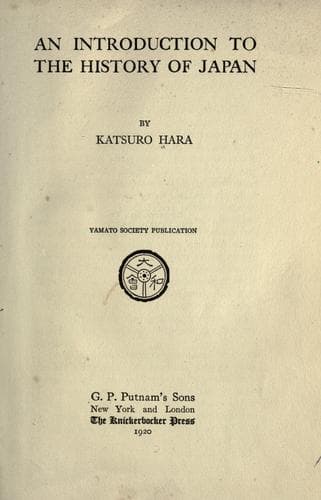
An Introduction to the History of JapanHara, Katsuro
History
An Introduction to the History of Japan
Hara, Katsuro
Japan -- History
This aspiring spirit of the nation not only made itself felt in the
importation of Chinese legislation, but also in adopting her arts and
literature. As to arts, it is difficult to ascertain to what degree of
accomplishment our forefathers had already attained before they came
under continental influence. Most probably it was limited to some simple
designs drawn on household utensils, _haniwa_ or terracotta-making, and
to an orchestra of rudimentary instruments. In what may be regarded as
literature, there were ballads, some of which are cited in the
_Nihongi_. Tales of heroic deeds, however, used to be transmitted from
generation to generation, not in the form of poetry, that is, not in
epic, but in oral prose narrations. In this respect the ancient Japanese
fell far short of the Ainu, who had developed a highly epic talent very
early. To summarise, the ancient Japanese apparently showed very few
indications of excelling other peoples in the same stage of civilisation
as regards arts and literature.
In the history of Japanese art, the introduction of Buddhism is a
noteworthy event. For, along with it, works of Chinese painting and
sculpture, both pertaining mainly to Buddhist worship, were sent as
presents to our imperial court by rulers of the peninsular states. Not
only articles of virtu, but also artists themselves, were sent over to
this country from the continent, who displayed their skill in building
temples, making images, decorating shrines with fresco paintings, and so
forth. Instructed by them, some gifted Japanese, too, became enabled to
develop themselves in several branches of art and artistic industry.
Among the plastic arts, painting was very slow in making progress,
though a few examples of that age which have remained to this day are
very similar in style to those pictures and frescoes recently excavated
out of the desert in northwestern China, and have a high historical
value, giving us a glimpse of the T'ang painting. Architecture was
perhaps the art most patronised by the court. We can see it in the
construction of numerous palaces. It is a well known fact that before
the Empress Gemmyo, who was one of the daughters of the Emperor Tenchi
and ascended the throne next after the Emperor Mommu, each successive
emperor established his court at the place he liked, and the residence
of the previous emperor was generally abandoned by the next-comer. From
this fact we can imagine that all imperial palaces of those times, if
they could be named palaces at all, must have been very simply built and
not very imposing. The locality, too, where the residence was
established, was hardly apt to be called a metropolitan city, although
it might have served sufficiently as a political centre of the time. It
was in the third year of the said empress, 710 A.D., that Nara was first
selected as the new capital which was to be established in permanence,
contrary to the hitherto accepted usage, and in fact it remained the
Public-domain text, read in full here on John Shaqi.
Reviews
Reviews
No reviews yet
Be the first to share your thoughts on this work.
Elsewhere in the archive
Join the Discussion
Join the discussion
Sign in to leave a comment or review.
Sign InorCreate an account