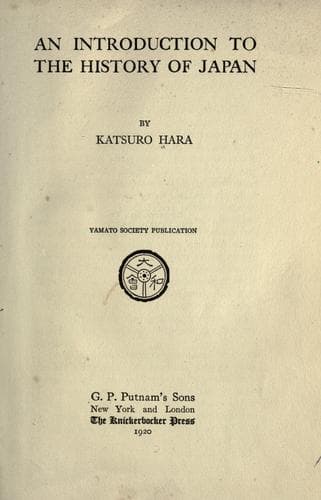
An Introduction to the History of JapanHara, Katsuro
History
An Introduction to the History of Japan
Hara, Katsuro
Japan -- History
From what has been stated above, one can well imagine that, in certain
respects, Japan of the Nara age had much in common with Greece just
about the time of the Persian invasion. In both it was an age in which a
vigorous race reached the first flourishing stage of civilisation, when
the national energy began to be devoted to aesthetic pursuits, but was
nevertheless not yet enervated by over-enlightenment. Whatever those
Japanese set their minds on doing, they set about it very briskly and
cheerfully, nor was their enthusiasm dampened by any fear of probable
mishap. Being naive, and therefore ignorant of obstacles inevitable to
the progress of a nation, they always soared higher and higher, full of
resplendent hope. How eager they were to essay at great things may be
conjectured from the size of the Daibutsu, the colossal statue of
Buddha, in the temple of the Todaiji at Nara. The statue, more than
fifty-three feet in height, was finished in 749 A.D. after several
successive failures encountered and overcome during four years, and is
the largest that was ever made in Japan. That such a great statue was
not only designed, but was executed by Japanese sculptors, whether their
origin be of immigrant stock or not, should be considered a great
credit to the enterprising spirit and the artistic acquirements of the
Japanese of that epoch.
Such a stride in the national progress, however, was only attained at
the expense of other quarters not at all insignificant. On the one hand,
it is true that Japan benefited immensely by having had as her neighbor
such a highly civilised country as China of the T'ang. On the other
hand, it should not be overlooked that it was a great misfortune to us
that we had such an over-shadowingly influential neighbour. China of
that time was a nation too far in advance of us to encourage us to
venture to compete with her. She left us no choice but to imitate her.
Who can blame the Japanese of the Nara age if they thought it the most
urgent business to run after China, and try to overtake her in the same
track down which they knew the Chinese had progressed a long way
already? The glory and splendour of the Chinese civilisation of the
T'ang was too enticing for them to turn their eyes aside and seek a yet
untrodden route. That they strove simply to imitate and rejoiced in
behaving as though they were real Chinese should not be a matter for
astonishment in the least. Perhaps it may be said to their credit that
the imitation was exquisite and the resemblance accurate. One of the
brilliant students then sent abroad remained there for eighteen years,
and after his return to this country he eventually became a prominent
minister of the Japanese government, notwithstanding his humble origin,
a promotion very rare in those days. Certain branches of Chinese
literature, many refined ceremonies, various kinds of Chinese pastimes,
many things Chinese, useful and beneficial to our people, to be found in
Public-domain text, read in full here on John Shaqi.
Reviews
Reviews
No reviews yet
Be the first to share your thoughts on this work.
Elsewhere in the archive
Join the Discussion
Join the discussion
Sign in to leave a comment or review.
Sign InorCreate an account