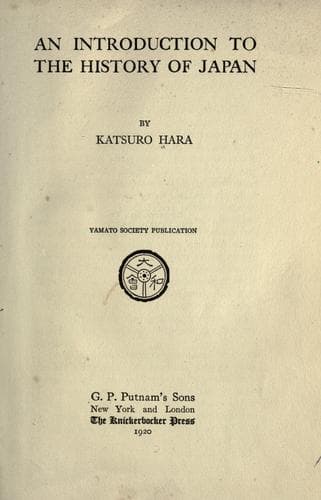
An Introduction to the History of JapanHara, Katsuro
History
An Introduction to the History of Japan
Hara, Katsuro
Japan -- History
Japan even to this day have been attributed to his importation. Another
scholar who was obliged to stay in China for more than fifty years,
distinguished himself in the literary circles of the Chinese metropolis,
was taken into the service of a T'ang emperor as a very high official
under a Chinese name, and at last died there with a life-long yearning
for his native country.
Such an imitation, however useful it might have proved in behalf of our
country at large, could not fail to exact from the nation still young,
as Japan was at that time, a tremendous overexertion of their mental
faculties. Having been strained to the last extremity of tension, the
Japanese became naturally exceedingly nervous. From a lack of patience
to observe quietly the maturing of the effect of a stack of laws and
regulations already enacted, they hastily repudiated some of them as if
they were of no use, and replaced them by new laws quite as confounding
as the previous ones, and thus legislations contradictory in principle
rapidly succeeded one another, none of them having had time enough to be
experimented with exhaustively. Although along with this rage for
imitation there was a strong countercurrent, very conservative, which
struggled incessantly to preserve what was original and at the same
time precious, yet to determine which was worthy of preservation was a
matter of bewilderment to the contemporaries, for they were averse from
coming into any collision with things Chinese to which they were not at
all loth. Excitement and irritation, the natural result of this
topsyturvy state of things, can best be estimated by the belief in
ridiculous auspices. The discovery of a certain plant or animal, of rare
colour or of unusual shape, generally caused by deformities, was
enthusiastically welcomed as an augury of a long and peaceful reign, and
was wont to call forth some lengthy imperial proclamation in praise of
the government. Bounties were munificently distributed to commemorate
the happy occasion, discoverers of these rarities were amply rewarded,
criminals were released or had the hardships of their servitude
ameliorated. Naturally, many of these auguries proved vain, and only
served as a prop to sustain the self-conceit of responsible ministers,
or as a means of soothing general discontent, if such discontent could
ever be manifested in those "good old times." The greatest evil of this
fatuous hankering for sources of self-satisfaction was the throng of
rogues and sycophants thereby produced who vied with one another in
contriving false or specious rarities and begging imperial favour for
them. Superstitions of this kind would have suited well enough a people
quite uncivilised, or too civilised to care for rational things. As for
the Japanese, a people already on the way of youthful progress, radiant
with hope, belief in auspices was but an intolerable fetter. If viewed
from this single point, therefore, the regime ought to have been
reformed by any means.
Public-domain text, read in full here on John Shaqi.
Reviews
Reviews
No reviews yet
Be the first to share your thoughts on this work.
Elsewhere in the archive
Join the Discussion
Join the discussion
Sign in to leave a comment or review.
Sign InorCreate an account