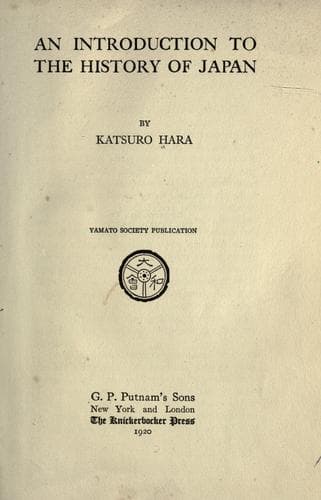
An Introduction to the History of JapanHara, Katsuro
History
An Introduction to the History of Japan
Hara, Katsuro
Japan -- History
The despatch of the official ships continued as in the days of Nara, not
at regular intervals, but generally once during the reign of every
Japanese emperor. The impetuous imitation of Chinese legislation
slackened in fact, for in that respect we had already borrowed enough.
The connection of our country with China began to take the form of
ordinary international intercourse, with due reciprocation of
courtesies. There remained, however, some need of keeping pace with the
political changes in China, and we could not make up our minds to
refrain altogether from peeping into the land which we held to be far
above our country in civilisation. The last of such an embassy was that
sent in the year 843. Half a century afterwards another squadron was
ordered to be despatched, and Sugawara-no-Michizane was appointed
ambassador. But the squadron was never really sent. For at that time the
long dynasty of the T'ang was just drawing near to its end, and the
civil war of a century's duration was beginning. There was no more any
stable government in China with which we could communicate. Moreover,
there was danger to be feared that we might be somehow embroiled in the
anarchical disturbances in the Middle Kingdom. The ambassador, Michizane
himself, was also of the opinion that little was to be gained by the
despatch of the intended squadron, and dissuaded the government from
sending it.
Japan now entered into the stage of the assimilation of the alien
culture already imported in full. Hitherto we had been too busy to make
discrimination among those things Chinese which we had engulfed at
random. Now we had to make clear which of them was suited, and how
others were to be modified in order to make them useful to our country.
In short, we had to digest; or to speak by the book, we had to ruminate
on what we had already taken. After all it must have been a wise policy
to put a stop to the state of national nervousness caused by the
incessant introduction of foreign laws, manners, customs, things. The
infiltration, however superficial it might have been, left an
ineradicable influence owing to the continual process of several
centuries. The spirit of the culture of the dominant class became
essentially Chinese. Though the saying, "Japanese spirit and Chinese
erudition" was henceforth fondly spoken of, the Japanese spirit itself
was not yet clearly defined, and did not enter into the full
consciousness of the nation. What the ruling nobles, who had imbibed the
Chinese spirit already too deeply, could do was only to discard things
which became superannuated and untenable.
Public-domain text, read in full here on John Shaqi.
Reviews
Reviews
No reviews yet
Be the first to share your thoughts on this work.
Elsewhere in the archive
Join the Discussion
Join the discussion
Sign in to leave a comment or review.
Sign InorCreate an account