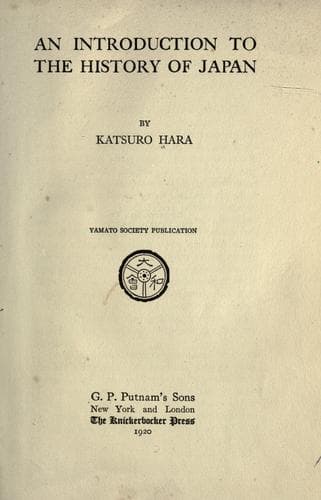
An Introduction to the History of JapanHara, Katsuro
History
An Introduction to the History of Japan
Hara, Katsuro
Japan -- History
The characteristics of the age of rumination may be discerned in the
history of our literature from the latter half of the ninth century to
the beginning of the eleventh. At first, while literary works were still
being written almost exclusively in Chinese, we begin to find in their
style traces of Japanisation, becoming more and more marked as time goes
on. Along with works in Chinese, those in our own language began to
appear, though very sparsely at first. Then gradually these attempts in
the vernacular increased, so that eventually the end of the tenth
century became the culminating period of the classical Japanese
literature. Religious and scholastic works were written in Chinese as
before. August and ceremonial documents continued to be composed in the
same language. Chinese poetry was as much in vogue among the courtiers
as ever. At the same time, however, numerous works in Japanese now
appeared in the form of chronicles, diaries, short stories, novels,
satirical sketches, and poems. What was most remarkable, however, is
that the greater part of those works was written not by men, but by
court ladies. Among the ladies, who by their wit and literary genius
brightened the court of the Emperor Ichijo, stood at the forefront
Murasaki-shikibu, the author of the _Genji-monogatari_, and
Sei-Shonagon, the author of _Makura-no-soshi_.
That these intelligent and talented court ladies were versed in Chinese
literature can be perceived in what they wrote in Japanese. In other
words, the culture, essentially Chinese, of the high circles of society
was not monopolised by the men only, but shared by the women. And these
court ladies were fairly emancipated, and far from being subject to the
caprices of men. It is often argued that the progress of a country can
be measured rightly by the social status of the women in it. If that be
true, Japan at the beginning of the eleventh century must have been very
highly civilised. And it was really so in a certain sense. This
civilised Japan, however, was confined to the very narrow circle in
Kyoto, and for that very circle the Chinese enlightenment penetrated too
deep. The great nobles of the Fujiwara family were too refined, too
effeminate for holders of the helm of the state, the young state in
which there was still much to be done vigorously.
Public-domain text, read in full here on John Shaqi.
Reviews
Reviews
No reviews yet
Be the first to share your thoughts on this work.
Elsewhere in the archive
Join the Discussion
Join the discussion
Sign in to leave a comment or review.
Sign InorCreate an account