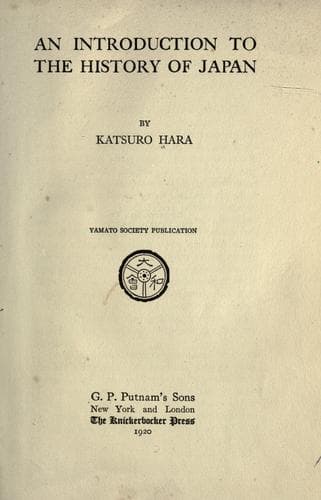
An Introduction to the History of JapanHara, Katsuro
History
An Introduction to the History of Japan
Hara, Katsuro
Japan -- History
The Ainu on the north were menacing as ever. For though they had lost in
extent of territory, they had gained in civilisation. The demand of the
state was for energetic ministers as well as for valiant warriors. The
high-class nobles became unfitted for both, and especially for the rough
life of the latter. As generals, therefore, not to speak of officers,
were employed men of comparatively low rank among the courtiers. In this
way military affairs became the hereditary profession of certain
families which happened to be engaged in them most frequently, and were
at last monopolised by them. As the government, however, could not and
did not care to provide these generals with a sufficiency of soldiers,
provisions, and armaments, they were obliged to help themselves to those
necessaries, just like the leaders of the landsknechts in Europe. The
intimate relation of vassalage, not legally recognised of course, thus
arose between those generals and their private soldiers, and as this
condition lasted for a considerable time, the relationship became
hereditary. Needless to say that such a condition of affairs was
naturally set up in the provinces, where the Ainu was still powerful
enough to raise frequent disturbances. On account of the fact that these
generals and their relatives were often appointed to the governorship of
distant provinces, where the influence of the Kyoto government was too
weak to check their arbitrary conduct, the same connection of vassalage
was formed there also between them and the provincials who were in need
of their protection. Not only did they thus become masters of bands of
strong and warlike people, but they also appropriated to themselves by
sundry means vast tracts of land, and fattened their purses thereby.
That they did not venture at once to overthrow the political regime
upheld by the nobles of the Fujiwara family may be accounted for by the
time-honoured prestige of the latter. For a long while those warriors
went even so far as to do homage to this or that noble of the Fujiwara
as his vassals, and served as tools to this or that party in court
intrigues. The courtiers, who employed them as their instruments, had no
apprehension that those military men, subservient for the moment to
their needs, would one day turn into rivals, powerful enough in the long
run to overturn them, and flattered themselves that they would remain as
their cat's-paws forever. An exact analogy of this in the history of
Rome may be found in the shortsightedness of the senate, which
complacently believed that the Scipios and the Caesars would for ever
remain obedient to their order. It would be a fatal mistake to think
that a cat's-paw would always remain docile and faithful to its
employer. Especially when it is frequently used and abused it becomes
conscious of its own usefulness and real strength; and self-assertion
is born. The next step for it must be the sounding of the strength of
Public-domain text, read in full here on John Shaqi.
Reviews
Reviews
No reviews yet
Be the first to share your thoughts on this work.
Elsewhere in the archive
Join the Discussion
Join the discussion
Sign in to leave a comment or review.
Sign InorCreate an account