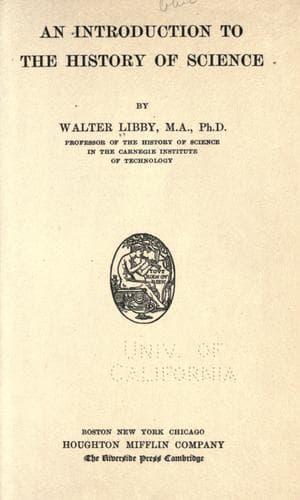
An Introduction to the History of ScienceLibby, Walter
History
An Introduction to the History of Science
Libby, Walter
Science -- History
Nearly all the old charges against American democracy can be
summarized in one general censure,--the lack of calm and reasoned
self-criticism,--and this general defect is rapidly being made good. It
is partly owing to charity and good-will, and it includes the toleration
of the mediocre or inferior, as, for example, in the theater; the
failure to recognize distinction, and to pay deference to things
deserving it; the glorification of the average man, and the _hustler_,
and the lack of special educational opportunities for the exceptionally
gifted child. That criticism as an art is still somewhat behindhand in
America seems to be confirmed by comparing French and American literary
criticism. In France it is a profession practiced by a corps of experts;
in America only a very few of the best periodicals can be relied on to
give reviews based on critical principles, of works in verse or prose.
(One American reviewer confesses that in a single day he has written
notices of twenty new works of fiction, his work bringing him, as
remuneration, seventy-five cents a volume.)
There is no evidence, however, that Americans as individuals are wanting
in the self-critical spirit. And for Arnold this is vital, seeing that
the watchword of the culture he proclaims is Know Thyself. It is not a
question of gaining a social advantage by a smattering of foreign
languages. It is more than intellectual curiosity. "Culture is more
properly described as having its origin in the love of perfection. It
moves by the force, not merely or primarily of the scientific passion
for pure knowledge, but also of the passion for doing good." Human
perfection, the essence of culture, is an internal condition, but the
will to do good must be guided by the knowledge of what is good to do;
"acting and instituting are of little use unless we know how and what we
ought to act and institute." Moreover, "because men are all members of
one great whole, and the sympathy which is human nature will not allow
one member to be indifferent to the rest, the expansion of our humanity,
to suit the idea of perfection which culture forms, must be a _general_
expansion."
For Arnold's contemporary Nietzsche, the German exponent of Aristocracy,
the _expansion_ of education entailed its diminution. For him ancient
Greece was the only home of culture, and such culture was not for all
comers. The rights of genius are not to be democratized; not the
education of the masses, but rather the education of a few picked men
must be the aim. The one purpose which education should most zealously
strive to achieve is the suppression of all ridiculous claims to
independent judgment, and the inculcation upon young men of obedience to
the scepter of genius. The scientific man and the cultured man belong to
two different spheres which, though coming together at times in the same
individual, are never fully reconciled.
Public-domain text, read in full here on John Shaqi.
Reviews
Reviews
No reviews yet
Be the first to share your thoughts on this work.
Elsewhere in the archive
Join the Discussion
Join the discussion
Sign in to leave a comment or review.
Sign InorCreate an account