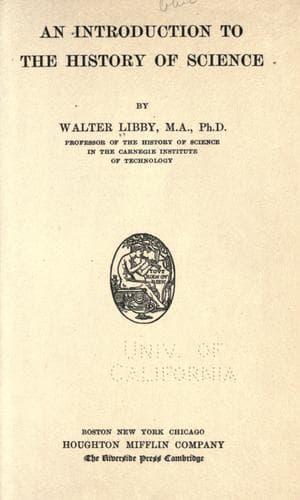
An Introduction to the History of ScienceLibby, Walter
History
An Introduction to the History of Science
Libby, Walter
Science -- History
Pliny the Elder (23-79 A.D.), in the encyclopedic work which he compiled
under the title _Natural History_, drew freely on hundreds of Greek and
Latin authors for his facts and fables. In the selection that he made
from his sources can be traced, as in the work of Vitruvius and other
Latin writers, the tendency to make the sciences subservient to the
arts. For example, the one thousand species of plants of which he makes
mention are considered from the medicinal or from the economic point of
view. It was largely in the interest of their practical uses that the
Roman regarded both plants and animals; his chief motive was not a
disinterested love of truth. Pliny thought that each plant had its
special virtue, and much of his botany is applied botany. So
comprehensive a work as the _Natural History_ was sure to contain
interesting anticipations of modern science. Pliny held that the earth
hovers in the heavens upheld by the air, that its sphericity is proved
by the fact that the mast of a ship approaching the land is visible
before the hull comes in sight. He also taught that there are
inhabitants on the other side of the earth (antipodes), that at the time
of the winter solstice the polar night must last for twenty-four hours,
and that the moon plays a part in the production of the tides.
Nevertheless, the whole book is permeated by the idea that the purpose
of nature is to minister to the needs of man.
It further marks the practical spirit among the Romans that a work on
agriculture by a Carthaginian (Mago) was translated by order of the
Senate. Cato (234-149 B.C.), so characteristically Roman in his genius,
wrote (_De Re Rustica_) concerning grains and the cultivation of fruits.
Columella wrote treatises on agriculture and forestry. Among the
technical writings of Varro besides the book on agriculture, which is
extant, are numbered works on law, mensuration, and naval tactics.
Public-domain text, read in full here on John Shaqi.
Reviews
Reviews
No reviews yet
Be the first to share your thoughts on this work.
Join the Discussion
Join the discussion
Sign in to leave a comment or review.
Sign InorCreate an account