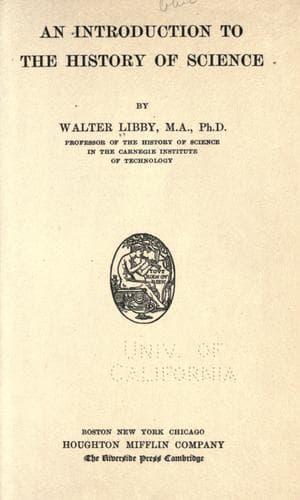
An Introduction to the History of Science — John Shaqi
An Introduction to the History of ScienceLibby, Walter
History
An Introduction to the History of Science
Libby, Walter
Science -- History
In the time of Harun Al-Rashid (800 A.D.), and his son, the Caliphate
of Bagdad was the center of Arab science. Mathematics and astronomy were
especially cultivated; an observatory was established; and the work of
translation was systematically carried on by a sort of institute of
translators, who rendered the writings of Aristotle, Hippocrates, Galen,
Euclid, Ptolemy, and other Greek scientists, into Arabic. The names of
the great Arab astronomers and mathematicians are not popularly known to
us; their influence is greater than their fame. One of them describes
the method pursued by him in the ninth century in taking measure of the
circumference of the earth. A second developed a trigonometry of sines
to replace the Ptolemaic trigonometry of chords. A third made use of the
so-called Arabic (really Hindu) system of numerals, and wrote the first
work on Algebra under that name. In this the writer did not aim at the
mental discipline of students, but sought to confine himself to what is
easiest and most useful in calculation, "such as men constantly require
in cases of inheritance, legacies, partition, law-suits, and trade, and
in all their dealings with one another, or where the measuring of lands,
the digging of canals, geometrical computation, and other objects of
various sorts and kinds are concerned."
In the following centuries Arab institutions of higher learning were
widely distributed and the flood-tide of Arab science was borne farther
west. At Cairo about the close of the tenth century the first accurate
records of eclipses were made, and tables were constructed of the
motions of the sun, moon, and planets. Here as elsewhere the Arabs
displayed ingenuity in the making of scientific apparatus, celestial
globes, sextants of large size, quadrants of various sorts, and
contrivances from which in the course of time were developed modern
surveying instruments for measuring horizontal and vertical angles.
Before the end of the eleventh century an Arab born at Cordova, the
capital of Moorish Spain, constructed the Toletan Tables. These were
followed in 1252 by the publication of the Alphonsine Tables, an event
which astronomers regard as marking the dawn of European science.
Public-domain text, read in full here on John Shaqi.
Reviews
Reviews
No reviews yet
Be the first to share your thoughts on this work.
Join the Discussion
Join the discussion
Sign in to leave a comment or review.
Sign InorCreate an account