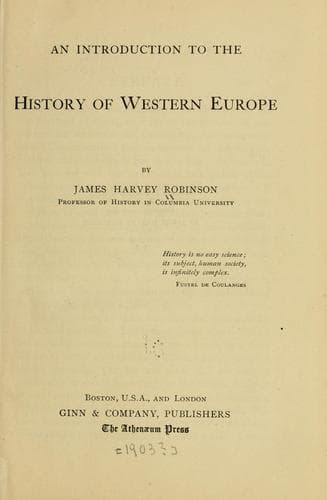
An Introduction to the History of Western EuropeRobinson, James Harvey
History
An Introduction to the History of Western Europe
Robinson, James Harvey
Europe -- History
"The Great Charter is the first great public act of the nation after it
has realized its own identity, the consummation of the work for which
unconsciously kings, prelates, and lawyers have been laboring for a
century. There is not a word in it that recalls the distinctions of race
and blood, or that maintains the differences of English and Norman law.
It is in one view the summing up of a period of national life, in
another the starting-point of a new period, not less eventful than that
which it closes" (Stubbs).
In spite of his solemn confirmation of the Charter, John, with his
accustomed treachery, made a futile attempt to abrogate his engagements;
but neither he nor his successors ever succeeded in getting rid of the
document. Later there were times when the English kings evaded its
provisions and tried to rule as absolute monarchs. But the people always
sooner or later bethought them of the Charter, which thus continued to
form an effective barrier against permanent despotism in England.
[Sidenote: Henry III, 1216-1272.]
55. During the long reign of John's son, Henry III, England began to
construct her Parliament, an institution which has not only played a
most important rôle in English history, but has also served as the model
for similar bodies in almost every civilized state in the world. Henry's
fondness for appointing foreigners to office, his anxiety to enjoy
powers which he had not the intelligence or energy to justify by the use
he made of them, and his willingness to permit the pope to levy taxes in
England, led the nobles to continue their hostility to the crown. The
nobles and the people of the towns, who were anxious to check the
arbitrary powers of the king, joined forces in what is known as the War
of the Barons. They found a leader in the patriotic Simon de Montfort,
who proved himself a valiant and unselfish defender of the rights of the
nation.
[Sidenote: The English Parliament.]
The older Witenagemot of Saxon times, as well as the Great Council of
the Norman kings, was a meeting of nobles, bishops, and abbots, which
the king summoned from time to time to give him advice and aid, and to
sanction important governmental undertakings. During Henry's reign its
meetings became more frequent and its discussions more vigorous than
before, and the name _Parliament_ began to be applied to it.
[Sidenote: Simon de Montfort summons the commons to Parliament.]
In 1265 a famous Parliament was held, where, through the influence of
Simon de Montfort, a most important new class of members--the
_commons_--was present, which was destined to give it its future
greatness. In addition to the nobles and prelates, the sheriffs were
ordered to summon two simple knights from each county and two citizens
from each of the more flourishing towns to attend and take part in the
discussions.
[Sidenote: The Model Parliament of Edward I, 1295.]
Public-domain text, read in full here on John Shaqi.
Reviews
Reviews
No reviews yet
Be the first to share your thoughts on this work.
Elsewhere in the archive
Join the Discussion
Join the discussion
Sign in to leave a comment or review.
Sign InorCreate an account