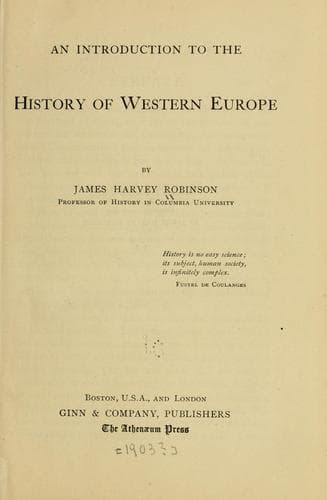
An Introduction to the History of Western EuropeRobinson, James Harvey
History
An Introduction to the History of Western Europe
Robinson, James Harvey
Europe -- History
Edward I, the next king, definitely adopted this innovation. He
doubtless called in the representatives of the towns because the
townspeople were becoming rich and he wished to have an opportunity to
ask them to make grants to meet the expenses of the government. He also
wished to obtain the approval of all classes when he determined upon
important measures affecting the whole realm. Since the Model Parliament
of 1295, the commons, or representatives of the people, have always been
included along with the clergy and nobility when the national assembly
of England has been summoned. We shall see later how the present houses
of Lords and Commons came into existence under Edward's son.
[Sidenote: England in the fourteenth century.]
From the reign of Edward I we are, as a distinguished English historian
has well said, "face to face with modern England. Kings, Lords, Commons,
the courts of justice, ... the relations of Church and State, in a great
measure the framework of society itself, have all taken the shape which
they still essentially retain" (Green). The English language was,
moreover, about to become the speech we use to-day.
CHAPTER XII
GERMANY AND ITALY IN THE TENTH AND ELEVENTH CENTURIES
[Sidenote: Contrast between the development of Germany and France.]
56. The history of the kingship in the eastern, or German, part of
Charlemagne's empire is very different from that in France, which was
reviewed in a previous chapter. After a struggle of four hundred years,
it had become clear by the thirteenth century that the successors of
Louis the German (Charlemagne's grandson) could not make of Germany a
kingdom such as St. Louis left to his descendants. From the thirteenth
century down to Napoleon's time there was no Germany in a political
sense, but only a great number of practically independent states, great
and small. It was but a generation ago that, under the leadership of
Prussia,--a kingdom unknown until many centuries after Charlemagne's
time,--the previously independent kingdoms, principalities, and free
towns were formed into the federation now known as the German empire.
[Sidenote: Stem duchies.]
Public-domain text, read in full here on John Shaqi.
Reviews
Reviews
No reviews yet
Be the first to share your thoughts on this work.
Elsewhere in the archive
Join the Discussion
Join the discussion
Sign in to leave a comment or review.
Sign InorCreate an account