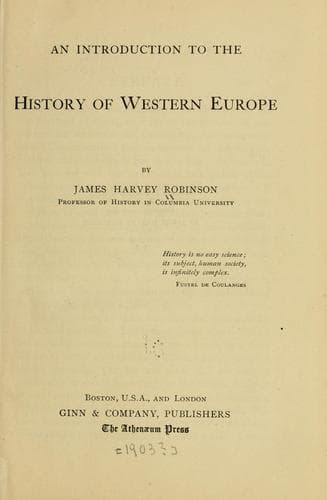
An Introduction to the History of Western EuropeRobinson, James Harvey
History
An Introduction to the History of Western Europe
Robinson, James Harvey
Europe -- History
[Sidenote: Henry V, 1106-1125.]
The achievement of the reign of Henry IV's son, Henry V, which chiefly
interests us was the adjustment of the question of investitures. Pope
Paschal II, while willing to recognize those bishops already chosen by
the king, provided they were good men, proposed that thereafter
Gregory's decrees against lay investiture should be carried out. The
clergy should no longer do homage and lay their hands, consecrated to
the service of the altar, in the blood-stained hands of the nobles.
Henry V, on the other hand, declared that unless the clergy took the
oath of fealty the bishops would not be given the lands, towns, castles,
tolls, and privileges attached to the bishoprics.
[Sidenote: Settlement of the question of lay investiture in the
Concordat of Worms, 1122.]
After a succession of troubles a compromise was at last reached in the
Concordat of Worms (1122), which put an end to the controversy over
investitures in Germany.[117] The emperor promised to permit the Church
freely to elect the bishops and abbots and renounced his old claim to
invest with the spiritual emblems of the ring and the crosier. But the
elections were to be held in the presence of the king, and he was
permitted, in a separate ceremony, to invest the new bishop or abbot
with his fiefs and secular prerogatives by a touch of the scepter. In
this way the spiritual rights of the bishops were obviously conferred by
the churchmen who elected him; and although the king might still
practically invalidate an election by refusing to invest with the
coveted temporal privileges, still the direct appointment of the bishops
and abbots was taken out of his hands. As for the emperor's control over
the papacy, too many popes, since the advent of Henry IV, had been
generally recognized as properly elected without the sanction of the
emperor, for any one to believe any longer that his sanction was
necessary.
CHAPTER XIV
THE HOHENSTAUFEN EMPERORS AND THE POPES
[Sidenote: Frederick I, Barbarossa, 1152-1190.]
[Sidenote: The historian, Otto of Freising.]
Public-domain text, read in full here on John Shaqi.
Reviews
Reviews
No reviews yet
Be the first to share your thoughts on this work.
Elsewhere in the archive
Join the Discussion
Join the discussion
Sign in to leave a comment or review.
Sign InorCreate an account