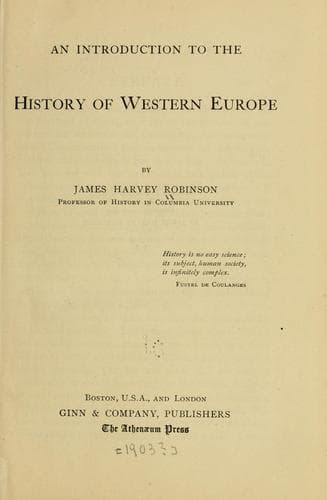
An Introduction to the History of Western EuropeRobinson, James Harvey
History
An Introduction to the History of Western Europe
Robinson, James Harvey
Europe -- History
66. Frederick I, nicknamed Barbarossa, i.e., "Redbeard," who became king
of Germany in 1152,[118] is the most interesting of all the German
emperors; and the records we have of his reign enable us to gain a
pretty good view of Europe in the middle of the twelfth century. With
his advent, we feel that we are emerging from that long period which
used to be known as the dark ages. Most of our knowledge of European
history from the sixth to the twelfth century is derived from meager and
unreliable monkish chronicles, whose authors were often ignorant and
careless, and usually far away from the scenes of the events they
recorded. In the latter half of the twelfth century, however,
information grows much more abundant and varied. We begin to have
records of the town life and are no longer entirely dependent upon the
monks' records. The first historian with a certain philosophic grasp of
his theme was Otto of Freising. His _Life of Frederick Barbarossa_ and
his history of the world form invaluable sources of knowledge of the
period we now enter.
[Sidenote: Frederick's ideal of the Empire.]
Frederick's ambition was to raise the Roman Empire to its old glory and
influence. He regarded himself as the successor of the Cæsars, of
Justinian, of Charlemagne, and of Otto the Great. He believed his office
to be quite as divinely established as the papacy. In announcing his
election to the pope, he stated that the Empire had been "bestowed upon
him by God," and he did not ask for the pope's sanction, as his
predecessors had done. But in his lifelong attempt to maintain what he
assumed to be the rights of the emperor he encountered all the old
difficulties. He had to watch his rebellious vassals in Germany and meet
the opposition of a series of unflinching popes, ready to defend the
most exalted claims of the papacy. He found, moreover, in the Lombard
cities unconquerable foes, who finally brought upon him a signal defeat.
[Sidenote: The towns begin to play a part in history.]
67. One of the most striking differences between the ages before
Frederick and the whole period since, lies in the development of town
life, with all that that implies. Up to this time we have heard only of
emperors, popes, bishops, and feudal lords; from now on the cities must
be reckoned with, as Frederick was to discover to his sorrow.[119]
[Sidenote: The government of the Lombard cities becomes partially
democratic.]
Public-domain text, read in full here on John Shaqi.
Reviews
Reviews
No reviews yet
Be the first to share your thoughts on this work.
Elsewhere in the archive
Join the Discussion
Join the discussion
Sign in to leave a comment or review.
Sign InorCreate an account