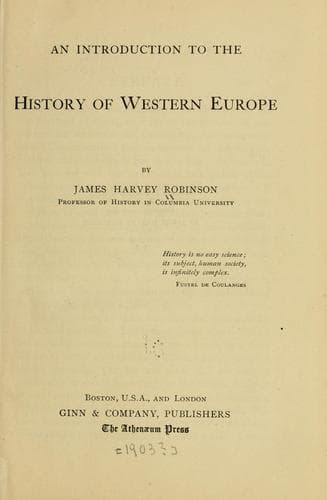
An Introduction to the History of Western EuropeRobinson, James Harvey
History
An Introduction to the History of Western Europe
Robinson, James Harvey
Europe -- History
69. The only hope for the Lombard towns was in _union_, which the
emperor had explicitly forbidden. Soon after Milan's destruction
measures were secretly taken to form the nucleus of what became later
the great Lombard League. Cremona, Brescia, Mantua, and Bergamo joined
together against the emperor. Encouraged by the pope and aided by the
League, Milan was speedily rebuilt. Frederick, who had been engaged in
conquering Rome with a view of placing an anti-pope on the throne of St.
Peter, was glad, in 1167, to escape the combined dangers of Roman fever
and the wrath of the towns and get back to Germany. The League was
extended to include Verona, Piacenza, Parma, and eventually many other
towns. It was even deemed best to construct an entirely new town, with a
view of harboring forces to oppose the emperor on his return, and
Alessandria remains a lasting testimonial to the energy and coöperative
spirit of the League. The new town got its name from the League's ally,
Pope Alexander III, one of the most conspicuous among the papal
opponents of the German kings.
[Sidenote: Frederick completely defeated by the League at Legnano,
1176.]
After several years spent in regulating affairs in Germany, Frederick
again appeared in Lombardy. He found the new "straw" town, as the
imperialists contemptuously called it, too strong for him. The League
got its forces together, and a great battle took place at Legnano in
1176,--a really decisive conflict, which was rare enough in the Middle
Ages. Frederick had been unable to get the reënforcements he wished from
across the Alps, and, under the energetic leadership of Milan, the
League so completely and hopelessly defeated him that the question of
the mastery in Lombardy was settled for some time.
[Sidenote: Peace of Constance (1183) establishes independence of Lombard
towns.]
A great congress was thereupon assembled at Venice, and here, under the
auspices of Pope Alexander III, a truce was concluded, which was made a
perpetual peace at Constance in 1183. The towns received back
practically all their regalia and, upon formally acknowledging the
emperor's overlordship, were left by him to go their own way. Frederick
was forced, moreover, humbly to recognize a pope that he had solemnly
sworn should never be obeyed by him. The pope and the towns had made
common cause and enjoyed a common victory.
[Sidenote: Origin of the power of the Guelfs.]
Public-domain text, read in full here on John Shaqi.
Reviews
Reviews
No reviews yet
Be the first to share your thoughts on this work.
Elsewhere in the archive
Join the Discussion
Join the discussion
Sign in to leave a comment or review.
Sign InorCreate an account