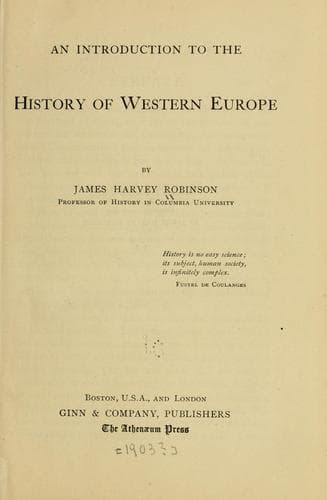
An Introduction to the History of Western EuropeRobinson, James Harvey
History
An Introduction to the History of Western Europe
Robinson, James Harvey
Europe -- History
From this time on we find the name _Guelf_ assumed by the party in Italy
which was opposed to the emperors.[122] This is but another form of the
name of the Welf family, who made most of the trouble for the
Hohenstaufens in Germany. A certain Welf had been made duke of Bavaria
by Henry IV (in 1070). His son added to the family estates by marrying a
rich north-German heiress. His grandson, Henry the Proud, looked still
higher and became the son-in-law of the duke of Saxony and the heir to
his great duchy. This, added to his other vast possessions, made him the
most powerful and dangerous of the vassals of the Hohenstaufen emperors.
[Sidenote: Division of Saxony and the other great German duchies.]
On returning from his disastrous campaign against the Lombard towns,
Frederick Barbarossa found himself at war with the Guelf leader, Henry
the Lion (son of Henry the Proud), who had refused to come to the
emperor's aid before the battle of Legnano. Henry was banished, and
Frederick divided up the Saxon duchy. His policy was to split up the old
duchies, for he clearly saw the danger of permitting his vassals to
control districts as large as he himself held.
[Sidenote: The Hohenstaufens extend their power into southern Italy.]
70. Before his departure upon the crusading expedition during which he
lost his life, Frederick saw his son, Henry VI, crowned king of Italy.
Moreover, in order to extend the power of the Hohenstaufens over
southern Italy, he arranged a marriage between the young Henry and
Constance, the heiress to the Norman kingdom of Naples and Sicily.[123]
Thus the hopeless attempt to keep both Germany and Italy under the same
head was continued. It brought about new conflicts with the popes, who
were the feudal suzerains of Naples and Sicily, and ended in the ruin of
the house of Hohenstaufen.
[Sidenote: Henry VI, 1190-1197.]
[Sidenote: His troubles in Italy and Germany.]
Henry VI's short reign was beset with difficulties which he sturdily met
and overcame. Henry the Lion, the Guelf leader, having broken the oath
he had sworn to Frederick to keep away from Germany, returned and
organized a rebellion. So soon as this was quelled and the Guelf party
was under control for a time, Henry VI had to hasten south to rescue his
Sicilian kingdom. There a certain Norman count, Tancred, was leading a
national revolt against the German claimant. The pope, who regarded
Sicily as his fief, had freed the emperor's Norman subjects from their
oath of fidelity to him. Moreover, Richard the Lion-Hearted of England
had landed on his way to the Holy Land and allied himself with Tancred.
Public-domain text, read in full here on John Shaqi.
Reviews
Reviews
No reviews yet
Be the first to share your thoughts on this work.
Elsewhere in the archive
Join the Discussion
Join the discussion
Sign in to leave a comment or review.
Sign InorCreate an account