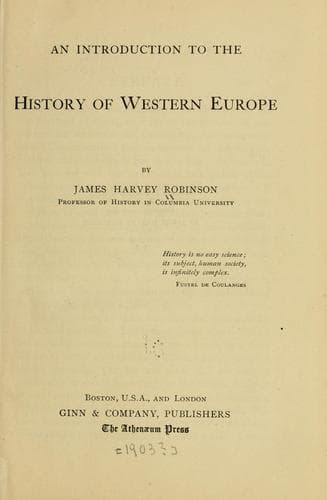
An Introduction to the History of Western EuropeRobinson, James Harvey
History
An Introduction to the History of Western Europe
Robinson, James Harvey
Europe -- History
2. The mediæval Church did not rely for its support, as churches usually
must to-day, upon the voluntary contributions of its members. It
enjoyed, in addition to the revenue from its vast tracts of lands and a
great variety of fees, the income from a regular tax, the _tithe_.
Those upon whom this fell were forced to pay it, just as we all must now
pay taxes imposed by the government.
[Sidenote: Resemblance of the Church to a state.]
3. It is obvious, moreover, that the mediæval Church was not merely a
religious body, as churches are to-day. Of course it maintained places
of worship, conducted devotional exercises, and cultivated the spiritual
life; but it did far more. It was, in a way, a state, for it had an
elaborate system of law, and its own courts, in which it tried many
cases which are now settled in our ordinary tribunals.[134] It had also
its prisons, to which it might sentence offenders to lifelong detention.
[Sidenote: Unity of organization in the Church.]
4. The Church not only performed the functions of a state; it had the
organization of a state. Unlike the Protestant ministers of to-day, all
churchmen and religious associations of mediæval Europe were under one
supreme head, who made laws for all and controlled every church officer,
wherever he might be, whether in Italy or Germany, Spain or Ireland. The
whole Church had one official language, Latin, in which all
communications were dispatched and in which its services were everywhere
conducted.
[Sidenote: The mediæval Church a monarchy in its form of government.]
79. The mediæval Church may, therefore, properly be called a monarchy in
its government. The pope was its all-powerful and absolute head and
concentrated in his person its entire spiritual and disciplinary
authority. He was the supreme lawgiver. No council of the Church, no
matter how large and important, could make laws against his will, for
its decrees, to be valid, required his sanction.
[Sidenote: Dispensations.]
The pope might, moreover, set aside or abrogate any law of the Church,
no matter how ancient, so long as it was not ordained by the Scriptures
or by Nature. He might, for good reasons, make exceptions to all merely
human laws; as, for instance, permit cousins to marry, or free a monk
from his vows. Such exceptions were known as _dispensations_.
[Sidenote: The pope the supreme judge of Christendom.]
Public-domain text, read in full here on John Shaqi.
Reviews
Reviews
No reviews yet
Be the first to share your thoughts on this work.
Elsewhere in the archive
Join the Discussion
Join the discussion
Sign in to leave a comment or review.
Sign InorCreate an account