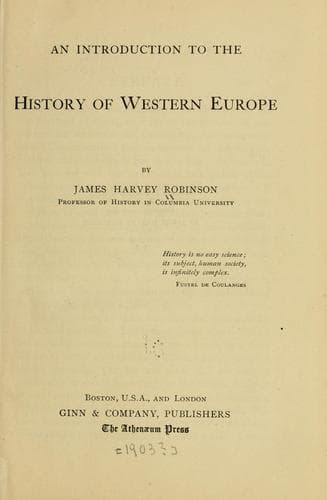
An Introduction to the History of Western EuropeRobinson, James Harvey
History
An Introduction to the History of Western Europe
Robinson, James Harvey
Europe -- History
The pope was not merely the supreme lawgiver; he was the supreme judge.
As a distinguished legal writer has said, the whole of western Europe
was subject to the jurisdiction of one tribunal of last resort, the
pope's court at Rome. Any one, whether clergyman or layman, in any part
of Europe, could appeal to him at any stage in the trial of a large
class of cases. Obviously this system had serious drawbacks. Grave
injustice might be done by carrying to Rome a case which ought to have
been settled in Edinburgh or Cologne, where the facts were best known.
The rich, moreover, always had the advantage, as they alone could afford
to bring suits before so distant a court.
[Sidenote: The control of the pope over the clergy at large.]
The control of the pope over the clergy scattered throughout Christendom
was secured in several ways. A newly elected archbishop might not
venture to perform any of the duties of his office until he had taken an
oath of fidelity and obedience to the pope and received from him the
_pallium_, the archbishop's badge of office. This was a narrow woolen
scarf made by the nuns of the convent of St. Agnes at Rome. Bishops and
abbots were also required to have their election duly confirmed by the
pope. He claimed, too, the right to settle the very frequent disputed
elections of church officials. He might even set aside both of the rival
candidates and fill the office himself, as did Innocent III when he
forced the monks of Canterbury, after a double election, to choose
Stephen Langton.
Since the time of Gregory VII the pope had claimed the right to depose
and transfer bishops at will. The control of Rome over all parts of the
Christian Church was further increased by the legates. These papal
emissaries were intrusted with great powers. Their haughty mien often
enough offended the prelates and rulers to whom they brought home the
authority of the pope,--as, for instance, when the legate Pandulf
grandly absolved all the subjects of King John of England, before his
very face, from their oath of fealty to him.
[Sidenote: The Roman Curia.]
The task assumed by the pope of governing the whole western world
naturally made it necessary to create a large body of officials at Rome
in order to transact all the multiform business and prepare and transmit
the innumerable legal documents.[135] The cardinals and the pope's
officials constituted what was called the papal Curia, or court.
[Sidenote: Sources of the pope's income.]
Public-domain text, read in full here on John Shaqi.
Reviews
Reviews
No reviews yet
Be the first to share your thoughts on this work.
Elsewhere in the archive
Join the Discussion
Join the discussion
Sign in to leave a comment or review.
Sign InorCreate an account