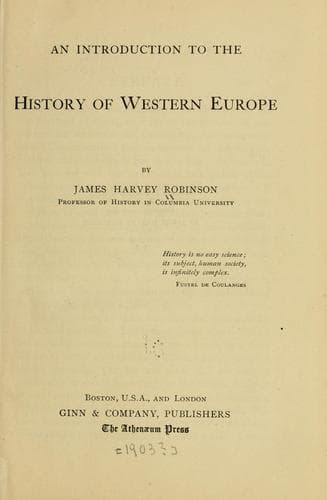
An Introduction to the History of Western EuropeRobinson, James Harvey
History
An Introduction to the History of Western Europe
Robinson, James Harvey
Europe -- History
92. Since the development of the rather new science of political
economy, historical writers have become much interested in the condition
and habits of the farmer, tradesman, and artisan in the Middle Ages.
Unfortunately no amount of research is likely to make our knowledge very
clear or certain regarding the condition of the people at large during
the five or six centuries following the barbarian invasions. It rarely
occurred to a mediæval chronicler to describe the familiar things about
him, such as the way in which the peasant lived and tilled his land.
Only the conspicuous personages and the startling events caught his
attention. Nevertheless enough is known of the mediæval manor and town
to make them very important subjects for the student of general history.
[Sidenote: Unimportance of town life in the early Middle Ages.]
There was little town life in western Europe before the twelfth century.
The Roman towns were decreasing in population before the German inroads.
The confusion which followed the invasions hastened their decline, and a
great number of them disappeared altogether. Those which survived and
such new towns as sprang up were, to judge from the chronicles, of very
little importance during the early Middle Ages. We may assume,
therefore, that during the long period from Theodoric to Frederick
Barbarossa by far the greater part of the population of England,
Germany, and northern and central France were living in the country, on
the great estates belonging to the feudal lords, abbots, and
bishops.[155]
[Sidenote: The manor, or vill.]
These mediæval estates were called _vills_, or _manors_, and closely
resembled the Roman villas described in an earlier chapter. A portion of
the estate was reserved by the lord for his own use; the rest of it was
divided up among the peasants,[156] usually in long strips, of which
each peasant had several scattered about the manor. The peasants were
generally serfs who did not own their fields, but could not, on the
other hand, be deprived of them so long as they worked for the lord and
paid him certain dues. They were attached to the land and went with it
when it changed hands. The serfs were required to till those fields
which the lord reserved for himself and to gather in his crops. They
might not marry without their lord's permission. Their wives and
children rendered such assistance as was necessary in the manor house.
In the women's buildings the daughters of the serfs engaged in spinning,
weaving, sewing, baking, and brewing, thus producing clothes, food, and
drink to be used by the whole community.
[Illustration: An English Manor House, Thirteenth Century]
[Sidenote: The obligations of the serfs.]
Public-domain text, read in full here on John Shaqi.
Reviews
Reviews
No reviews yet
Be the first to share your thoughts on this work.
Elsewhere in the archive
Join the Discussion
Join the discussion
Sign in to leave a comment or review.
Sign InorCreate an account