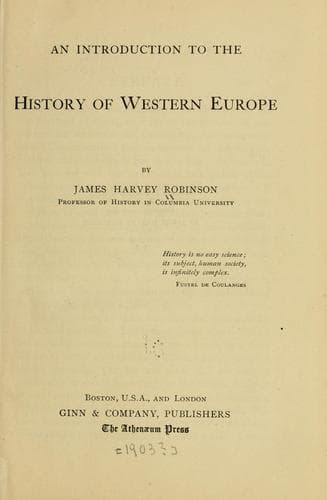
An Introduction to the History of Western EuropeRobinson, James Harvey
History
An Introduction to the History of Western Europe
Robinson, James Harvey
Europe -- History
We get our clearest ideas of the position of the serfs from the ancient
descriptions of manors, which give an exact account of what each member
of a particular community owed to the lord. For example, we find that
the abbot of Peterborough held a manor upon which Hugh Miller and
seventeen other serfs, mentioned by name, were required to work for him
three days in each week during the whole year, except one week at
Christmas, one at Easter, and one at Whitsuntide. Each serf was to give
the lord abbot one bushel of wheat and eighteen sheaves of oats, three
hens and one cock yearly, and five eggs at Easter. If he sold his horse
for more than ten shillings, he was to give the said abbot four pence.
Five other serfs, mentioned by name, held but half as much land as Hugh
and his companions, by paying and doing in all things half as much
service.
There were sometimes a few people on the manor who did not belong to the
great body of cultivators. The limits of the manor and those of the
parish often coincided; in that case there would be a priest who had
some scattered acres and whose standing was naturally somewhat superior
to that of the people about him. Then the miller, who ground the flour
and paid a substantial rent to the lord, was generally somewhat better
off than his neighbors, and the same may be said of the blacksmith.
[Sidenote: The manor independent of the outside world.]
One of the most remarkable characteristics of the manor was its
independence of the rest of the world. It produced nearly everything
that its members needed and might almost have continued to exist
indefinitely without communication with those who lived beyond its
bounds. Little or no money was necessary, for the peasants paid what was
due to the lord in the form of labor and farm products. They also
rendered the needful help to one another and found little occasion for
buying and selling.
[Sidenote: The monotony and misery of the peasants' lives.]
There was almost no opportunity to better one's condition, and life, in
the greater part of the hamlets, must have gone on for generation after
generation in a weary routine. The life was not merely monotonous, it
was miserable. The food was coarse and there was little variety, as the
peasants did not even take pains to raise fresh vegetables. The houses
usually had but one room. This was ill-lighted by a single little window
and had no chimney.
[Sidenote: The manor court.]
Public-domain text, read in full here on John Shaqi.
Reviews
Reviews
No reviews yet
Be the first to share your thoughts on this work.
Elsewhere in the archive
Join the Discussion
Join the discussion
Sign in to leave a comment or review.
Sign InorCreate an account