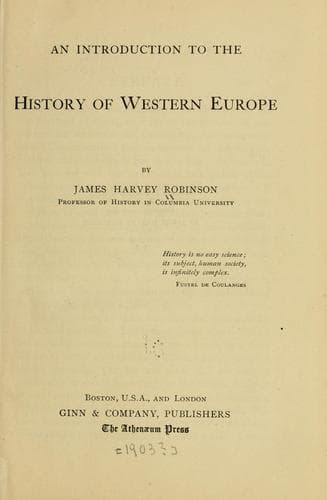
An Introduction to the History of Western EuropeRobinson, James Harvey
History
An Introduction to the History of Western Europe
Robinson, James Harvey
Europe -- History
Yet the very dependence upon one another can hardly have failed to
produce a certain spirit of brotherhood and mutual assistance in the
community. It was not only separated from the outside world, but its
members were brought together constantly by their intermingled fields,
their attendance at one church, and their responsibility to one
proprietor. The men were all expected to be present at the "court" which
was held in each manor, where the business of the manor was transacted
under the supervision of a representative of the lord. Here, for
instance, disputes were settled, fines imposed for the violation of the
customs of the manor, and redistributions of the strips of land took
place.
[Sidenote: The serf an inferior farmer who could only exist when there
was plenty of land.]
The serf was ordinarily a bad farmer and workman. He cultivated the soil
in a very crude manner, and his crops were accordingly scanty and
inferior. Obviously serfdom could exist only as long as land was
plentiful. But in the twelfth and thirteenth century western Europe
appears to have been gaining steadily in population. Serfdom would,
therefore, naturally tend to disappear when the population so increased
that the carelessly cultivated fields no longer supplied the food
necessary for the growing numbers.
[Sidenote: Barter replaced by money transactions.]
The increased use of money in the twelfth and thirteenth centuries,
which came with the awakening trade and industry, also tended to break
up the manor. The old habit of bartering one thing for another without
the intervention of money began to disappear. As time went on, neither
the lord nor the serf was satisfied with the ancient primitive
arrangements, which had answered well enough in the time of Charlemagne.
The serfs, on the one hand, began to obtain money by the sale of their
products in the markets of neighboring towns. They soon found it more
profitable to pay the lord a certain sum instead of working for him, for
they could then turn their whole attention to their own farms. The
proprietors, on the other hand, found it to their advantage to accept
money in place of the services of their tenants. With this money the
landlord could hire laborers to cultivate his fields and could buy the
luxuries which were brought to his notice as commerce increased. So it
came about that the lords gradually renounced their control over the
peasants, and the serf was no longer easily distinguishable from the
freeman who paid a regular rent for his land.[157] A serf might also
gain his liberty by fleeing to a town. If he remained undiscovered, or
was unclaimed by his lord, for a year and a day, he became a freeman.
[Sidenote: Disappearance of serfdom.]
Public-domain text, read in full here on John Shaqi.
Reviews
Reviews
No reviews yet
Be the first to share your thoughts on this work.
Elsewhere in the archive
Join the Discussion
Join the discussion
Sign in to leave a comment or review.
Sign InorCreate an account