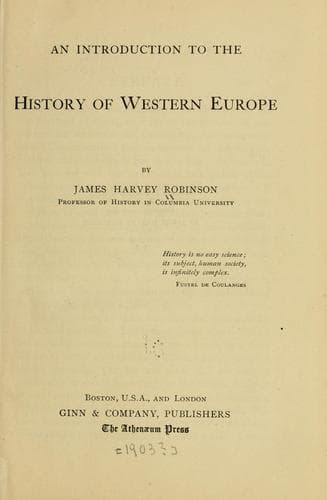
An Introduction to the History of Western Europe — John Shaqi
An Introduction to the History of Western EuropeRobinson, James Harvey
History
An Introduction to the History of Western Europe
Robinson, James Harvey
Europe -- History
During the three hundred years before the invasions those who read at
all did not ordinarily take the trouble to study the classics, but
relied upon mere collections of quotations; and for what they called
science, upon compendiums and manuals. These the Middle Ages inherited,
and it was not until the time of Petrarch, in the fourteenth century,
that Europe once more reached a degree of cultivation which enabled the
more discriminating scholars to appreciate the best productions of the
great authors of antiquity, both Greek and Latin.[2]
[Sidenote: Preparation for Christianity.]
In spite of the general decline of which we have been speaking, the
Roman world appeared to be making progress in one important respect.
During the first and second centuries a sort of moral revival took place
and a growing religious enthusiasm showed itself, which prepared the way
for the astonishingly rapid introduction of the new Christian religion.
Some of the pagan philosophers had quite given up the old idea which we
find in Homer and Virgil, that there were many gods, and had reached an
elevated conception of the one God and of our duty toward Him. "Our
duty," writes the philosopher Epictetus at the end of the first century,
"is to follow God, ... to be of one mind with Him, to devote ourselves
to the performance of His commands." The emperor Marcus Aurelius (d.
180) expresses similar sentiments in his _Meditations_,[3] the notes
which he wrote for his own guidance. There was a growing abhorrence for
the notorious vices of the great cities, and an ever-increasing demand
for pure and upright conduct. The pagan religions taught that the souls
of the dead continued to exist in Hades; but the life to come was
believed to be a dreary existence at best.
[Sidenote: Promises of Christianity.]
Christianity brought with it a new hope for all those who would escape
from the bondage of sin, of which the serious-minded were becoming more
and more conscious. It promised, moreover, eternal happiness after death
to all who would consistently strive to do right. It appealed to the
desires and needs of all kinds of men and women. For every one who
accepted the Gospel might look forward in the next world to such joy as
he could never hope to experience in this.
[Sidenote: Christianity and paganism tend to merge into one another.]
[Sidenote: Boethius.]
Public-domain text, read in full here on John Shaqi.
Reviews
Reviews
No reviews yet
Be the first to share your thoughts on this work.
Join the Discussion
Join the discussion
Sign in to leave a comment or review.
Sign InorCreate an account