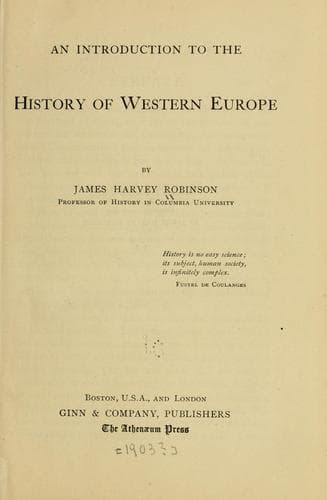
An Introduction to the History of Western EuropeRobinson, James Harvey
History
An Introduction to the History of Western Europe
Robinson, James Harvey
Europe -- History
To begin with, the Middle Ages differed from our own time in the very
general use then made of Latin, both in writing and speaking. In the
thirteenth century, and long after, all books that made any claim to
learning were written in Latin;[159] the professors in the universities
lectured in Latin, friends wrote to one another in Latin, and state
papers, treaties, and legal documents were drawn up in the same
language. The ability of every educated person to make use of Latin, as
well as of his native tongue, was a great advantage at a time when there
were many obstacles to intercourse among the various nations. It helps
to explain, for example, the remarkable way in which the pope kept in
touch with all the clergymen of western Christendom, and the ease with
which students, friars, and merchants could wander from one country to
another. There is no more interesting or important revolution than that
by which the language of the people in the various European countries
gradually pushed aside the ancient tongue and took its place, so that
even scholars scarcely ever think now of writing books in Latin.
In order to understand how it came about that two languages, the Latin
and the native speech, were both commonly used in all the countries of
western Europe all through the Middle Ages, we must glance at the origin
of the modern languages. These all fall into two quite distinct groups,
the Germanic and the Romance.
[Sidenote: The Germanic languages derived from the dialects of the
German barbarians.]
Those German peoples who had continued to live outside of the Roman
Empire, or who, during the invasions, had not settled far enough within
its bounds to be led, like the Franks in Gaul, to adopt the tongue of
those they had conquered, naturally adhered to the language they had
always used, namely, the particular Germanic dialect which their
forefathers had spoken for untold generations. From the various
languages spoken by the German barbarians, modern German, English,
Dutch, Swedish, Norwegian, Danish, and Icelandic are derived.
[Sidenote: The Romance languages derived from the spoken Latin.]
Public-domain text, read in full here on John Shaqi.
Reviews
Reviews
No reviews yet
Be the first to share your thoughts on this work.
Elsewhere in the archive
Join the Discussion
Join the discussion
Sign in to leave a comment or review.
Sign InorCreate an account