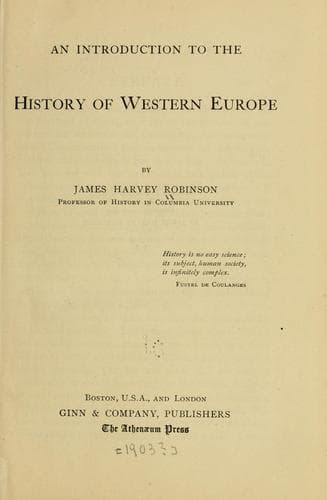
An Introduction to the History of Western EuropeRobinson, James Harvey
History
An Introduction to the History of Western Europe
Robinson, James Harvey
Europe -- History
The second group of languages developed within the territory which had
formed a part of the Roman Empire, and includes modern French, Italian,
Spanish, and Portuguese. It has now been clearly proved, by a very
minute study of the old forms of words, that these Romance languages
were one and all derived from the _spoken_ Latin, employed by the
soldiers, merchants, and people at large. This differed considerably
from the elaborate and elegant written Latin which was used, for
example, by Cicero and Cæsar. It was undoubtedly much simpler in its
grammar and doubtless varied a good deal in different regions;--a Gaul,
for instance, could not pronounce the words like an Italian. Moreover,
in conversation people did not always use the same words as those in the
books. For example, a horse was commonly spoken of as _caballus_,
whereas a writer would use the word _equus_; it is from _caballus_ that
the word for horse is derived in Spanish, Italian, and French
(_caballo_, _cavallo_, _cheval_).
As time went on the spoken language diverged farther and farther from
the written. Latin is a troublesome speech on account of its complicated
inflections and grammatical rules, which can be mastered only after a
great deal of study. The people of the Roman provinces and the incoming
barbarians naturally paid very little attention to the niceties of
syntax and found easy ways of saying what they wished.[160] Yet several
centuries elapsed after the German invasions before there was anything
written in the language of conversation. So long as the uneducated could
understand the correct Latin of the books when they heard it read or
spoken, there was no necessity of writing anything in their familiar
daily speech. But the gulf between the spoken and the written language
had become so great by the time Charlemagne came to the throne, that he
advised that sermons should be given thereafter in the language of the
people, who, apparently, could no longer follow the Latin. The Strasburg
oaths[161] are, however, about the first example which has come down to
us of the speech which was growing into French.
[Sidenote: Earliest examples of the Germanic languages.]
[Sidenote: Gothic.]
Public-domain text, read in full here on John Shaqi.
Reviews
Reviews
No reviews yet
Be the first to share your thoughts on this work.
Elsewhere in the archive
Join the Discussion
Join the discussion
Sign in to leave a comment or review.
Sign InorCreate an account