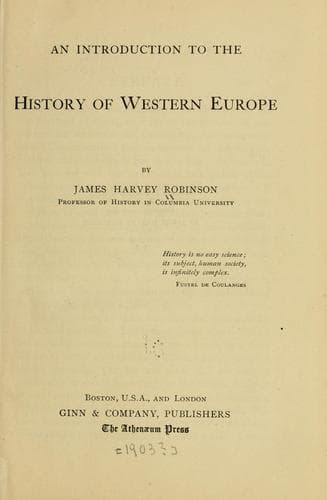
An Introduction to the History of Western EuropeRobinson, James Harvey
History
An Introduction to the History of Western Europe
Robinson, James Harvey
Europe -- History
As the Gothic style developed and the builders grew all the time more
skillful and daring, the churches became marvels of lightness and
delicacy of detail and finish, while still retaining their dignity and
beauty of proportion. Sculptors enriched them with the most beautiful
creations of their art. Moldings and capitals, pulpits, altars, and
choir screens, the wooden seats for the clergy and choristers, are
sometimes literally covered with carving representing graceful leaf and
flower forms, familiar animals or grotesque monsters, biblical incidents
or homely scenes from everyday life. In the cathedral of Wells, in
England, one capital shows us among its vines and leaves a boy whose
face is screwed up with pain from the thorn he is extracting from his
foot; another depicts a whole story of sin found out, thieves stealing
grapes pursued by an angry farmer with a pitchfork. One characteristic
of the mediæval imagination is its fondness for the grotesque. It loved
queer beasts, half eagle, half lion, hideous batlike creatures, monsters
like nothing on land or sea. They lurk among the foliage on choir
screens, leer at you from wall or column, or squat upon the gutters high
on roof and steeple.
[Illustration: Window in the Cathedral of Sens, France]
[Sidenote: Gothic sculpture.]
A striking peculiarity of the Gothic structure is the great number of
statues of apostles, saints, and rulers which adorn the façades and
especially the main portal of the churches. These figures are cut from
the same kind of stone of which the building is made and appear to be
almost a part of it. While, compared with later sculpture, they seem
somewhat stiff and unlifelike, they harmonize wonderfully with the whole
building, and the best of them are full of charm and dignity.
[Illustration: INTERIOR OF EXETER CATHEDRAL]
[Sidenote: Secular buildings.]
So far we have spoken only of the church architecture, and that was by
far the most important during the period with which we have been
dealing. Later, in the fourteenth century, many beautiful secular
buildings were constructed in the Gothic style. The most striking and
important of these were the guildhalls built by the rich merchant
guilds, and the townhalls of some of the important cities. But the
Gothic style has always been especially dedicated to, and seems
peculiarly fitted for, ecclesiastical architecture. Its lofty aisles and
open floor spaces, its soaring arches leading the eye toward heaven, and
its glowing windows suggesting the glories of paradise, may well have
fostered the ardent faith of the mediæval Christian.
[Illustration: Figures (gargoyles) on Notre Dame, Paris]
[Sidenote: The mediæval castle.]
Public-domain text, read in full here on John Shaqi.
Reviews
Reviews
No reviews yet
Be the first to share your thoughts on this work.
Elsewhere in the archive
Join the Discussion
Join the discussion
Sign in to leave a comment or review.
Sign InorCreate an account