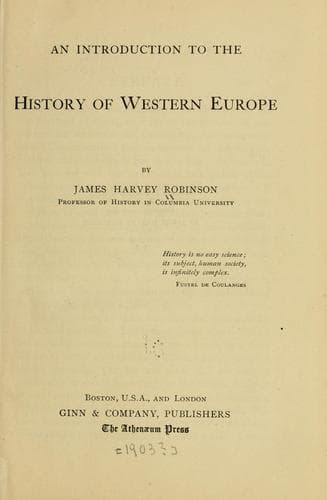
An Introduction to the History of Western EuropeRobinson, James Harvey
History
An Introduction to the History of Western Europe
Robinson, James Harvey
Europe -- History
We have already touched upon some of the characteristics of domestic
architecture in referring to the mediæval castle. This was rather a
stronghold than a home,--strength and inaccessibility were its main
requirements. The walls were many feet thick and the tiny windows, often
hardly more than slits in the massive walls, the stone floors, the great
bare halls warmed only by large fireplaces, suggest nothing of the
comfort of a modern household. At the same time they imply a simplicity
of taste and manners and a hardihood of body which we may well envy.
[Sidenote: The schools before the eleventh century.]
103. On turning from the language and books of the people and the art of
the period to the occupations of the learned class, who carried on their
studies and discussions in Latin, we naturally inquire where such
persons obtained their education. During the long centuries which
elapsed between the time when Justinian closed the government schools
and the advent of Frederick Barbarossa, there appears to have been
nothing in western Europe, outside of Italy and Spain, corresponding to
our universities and colleges. Some of the schools which the bishops and
abbots had established in accordance with Charlemagne's commands were,
it is true, maintained all through the dark and disorderly times which
followed his death. But the little that we know of the instruction
offered in them would indicate that it was very elementary, although
there were sometimes noted men at their head.
[Sidenote: Abelard, d. 1142.]
About the year 1100 an ardent young man named Abelard started out from
his home in Brittany to visit all the places where he might hope to
receive instruction in logic and philosophy, in which, like all his
learned contemporaries, he was especially interested. He reports that he
found teachers in several of the French towns, particularly in Paris,
who were attracting large numbers of students to listen to their
lectures upon logic, rhetoric, and theology. Abelard soon showed his
superiority to his teachers by defeating them several times in debate.
Before long he began lecturing on his own account, and such was his
success that thousands of students flocked to hear him.
[Sidenote: Abelard's _Yea and Nay_.]
Public-domain text, read in full here on John Shaqi.
Reviews
Reviews
No reviews yet
Be the first to share your thoughts on this work.
Elsewhere in the archive
Join the Discussion
Join the discussion
Sign in to leave a comment or review.
Sign InorCreate an account