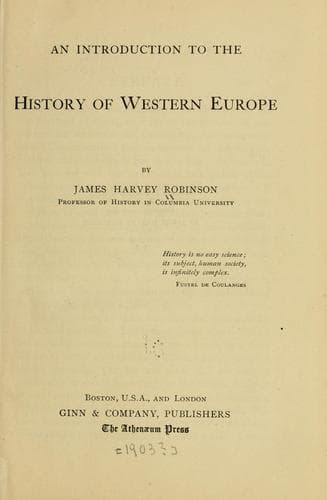
An Introduction to the History of Western EuropeRobinson, James Harvey
History
An Introduction to the History of Western Europe
Robinson, James Harvey
Europe -- History
He prepared a remarkable little text-book, called _Yea and Nay_,
containing seemingly contradictory opinions of the church fathers upon
particular questions. The student was left to reconcile the
contradictions, if he could, by careful reasoning; for Abelard held that
a constant questioning was the only path to real knowledge. His free way
of dealing with the authorities upon which men based their religious
beliefs seemed wicked to many of his contemporaries, especially to St.
Bernard, who made him a great deal of trouble. Nevertheless it soon
became the fashion to discuss the various doctrines of Christianity with
great freedom and to try to make a well-reasoned system of theology by
following the rules of Aristotle's logic. It was just after Abelard's
death (1142) that Peter Lombard published his _Sentences_, already
described.
Abelard did not found the University of Paris, as has sometimes been
supposed, but he did a great deal to make the discussions of theological
problems popular, and by his attractive method of teaching he greatly
increased the number of those who wished to learn. The sad story of his
life, which he wrote when he was worn out with the calamities that had
overtaken him, is the best and almost the only account which exists of
the remarkable interest in learning which explains the origin of the
University of Paris.[173]
[Sidenote: Origin of the University of Paris.]
Before the end of the twelfth century the teachers had become so
numerous in Paris that they formed a union, or guild, for the
advancement of their interests. This union of professors was called by
the usual name for corporations in the Middle Ages, _universitas_; hence
our word "university." The king and pope both favored the university and
granted the teachers and students many of the privileges of the clergy,
a class to which they were regarded as belonging, because learning had
for so many centuries been confined to the clergy.
[Sidenote: Study of the Roman and canon law in Bologna.]
[Sidenote: The _Decretum_ of Gratian.]
Public-domain text, read in full here on John Shaqi.
Reviews
Reviews
No reviews yet
Be the first to share your thoughts on this work.
Elsewhere in the archive
Join the Discussion
Join the discussion
Sign in to leave a comment or review.
Sign InorCreate an account