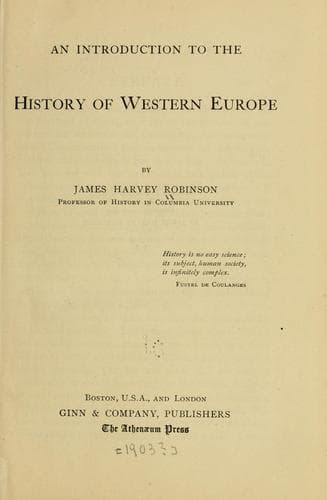
An Introduction to the History of Western Europe — John Shaqi
An Introduction to the History of Western EuropeRobinson, James Harvey
History
An Introduction to the History of Western Europe
Robinson, James Harvey
Europe -- History
A sharp distinction was already made between the officers of the Church,
who were called the _clergy_, and the people, or _laity_. To the clergy
was committed the government of the Church as well as the instruction of
its members. In each of the Roman cities was a bishop, and at the head
of the country communities, a priest (Latin, _presbyter_), who had
succeeded to the original elders (presbyters) mentioned in the New
Testament. Below the bishop and the priest were the lower orders of the
clergy,--the deacon and sub-deacon,--and below these the so called minor
orders--the acolyte, exorcist, reader, and doorkeeper. The bishop
exercised a certain control over the priests within his territory. It
was not unnatural that the bishops in the chief towns of the Roman
provinces should be especially influential in church affairs. They came
to be called _archbishops_, and might summon the bishops of the
province to a council to decide important matters.
[Sidenote: The first general council, 325. Position of the Bishop of
Rome during this period.]
In 311 the emperor Galerius issued a decree placing the Christian
religion upon the same legal footing as paganism. Constantine, the first
Christian emperor, carefully enforced this edict. In 325 the first
general council of Christendom was called together under his auspices at
Nicæa. It is clear from the decrees of this famous assembly that the
Catholic Church had already assumed the form that it was to retain down
to the present moment, except that there is no explicit recognition of
the Bishop of Rome as the head of the whole church. Nevertheless, there
were a number of reasons--to be discussed later--why the Bishop of Rome
should sometime become the acknowledged ruler of western Christendom.
The first of the Roman bishops to play a really important part in
authentic history was Leo the Great, who did not take office until
440.[6]
[Sidenote: The Church in the Theodosian Code.]
Public-domain text, read in full here on John Shaqi.
Reviews
Reviews
No reviews yet
Be the first to share your thoughts on this work.
Join the Discussion
Join the discussion
Sign in to leave a comment or review.
Sign InorCreate an account