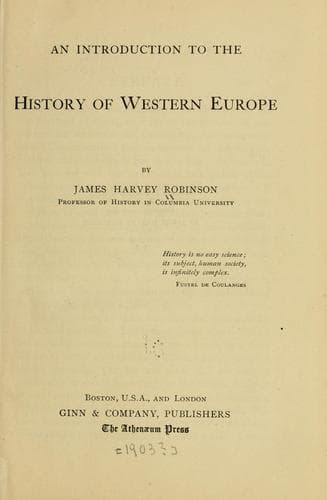
An Introduction to the History of Western EuropeRobinson, James Harvey
History
An Introduction to the History of Western Europe
Robinson, James Harvey
Europe -- History
Henry V had no real basis for his claim to the French crown. Edward III
had gone to war because France was encroaching upon Guienne and aiding
Scotland, and because he was encouraged by the Flemish towns. Henry V,
on the other hand, was merely anxious to make himself and his house
popular by deeds of valor. Nevertheless his very first victory, the
battle of Agincourt, was as brilliant as that of Crécy or Poitiers. Once
more the English bowmen slaughtered great numbers of French knights. The
English then proceeded to conquer Normandy and march upon Paris.
[Sidenote: Treaty of Troyes, 1420.]
Burgundians and Orleanists were upon the point of forgetting their
animosities in their common fear of the English, when the duke of
Burgundy, as he was kneeling to kiss the hand of his future sovereign,
the Dauphin,[189] was treacherously attacked and killed by a band of his
enemies. His son, the new duke of Burgundy, Philip the Good, immediately
joined the English against the Dauphin, whom he believed to be
responsible for his father's murder. Henry then forced the French to
sign the treaty of Troyes (1420), which provided that he was to become
king of France upon the death of the mad Charles VI.
[Sidenote: Henry VI recognized as king in northern France.]
Both Henry V and Charles VI died two years later. Henry V's son, Henry
VI, was but nine months old; nevertheless according to the terms of the
treaty of Troyes he succeeded to the throne in France as well as in
England. The child was recognized only in a portion of northern France.
Through the ability of his uncle, the duke of Bedford, his interests
were defended with such good effect that the English succeeded in a few
years in conquering all of France north of the Loire, although the south
continued to be held by Charles VII, the son of Charles VI.
[Sidenote: Joan of Arc.]
Charles VII had not yet been crowned and so was still called the Dauphin
even by his supporters. Weak and indolent, he did nothing to stem the
tide of English victories or restore the courage and arouse the
patriotism of his distressed subjects. This great task was reserved for
a young peasant girl from a remote village on the eastern border of
France. To her family and her companions Joan of Arc seemed only "a good
girl, simple and pleasant in her ways," but she brooded much over the
disasters that had overtaken her country, and a "great pity on the fair
realm of France" filled her heart. She saw visions and heard voices that
bade her go forth to the help of the king and lead him to Rheims to be
crowned.
[Sidenote: Relief of Orleans by Joan, 1429.]
Public-domain text, read in full here on John Shaqi.
Reviews
Reviews
No reviews yet
Be the first to share your thoughts on this work.
Elsewhere in the archive
Join the Discussion
Join the discussion
Sign in to leave a comment or review.
Sign InorCreate an account