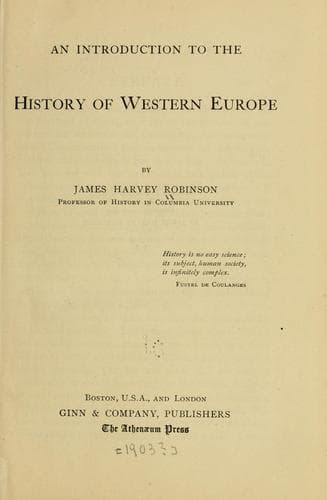
An Introduction to the History of Western EuropeRobinson, James Harvey
History
An Introduction to the History of Western Europe
Robinson, James Harvey
Europe -- History
The English Parliament became more and more reluctant to grant funds
when there were no more victories gained. Bedford, through whose ability
the English cause had hitherto been maintained, died in 1435, and Philip
the Good, Duke of Burgundy, renounced his alliance with the English and
joined Charles VII. Owing to his acquisition of the Netherlands, the
possessions of Philip were now so great that he might well be regarded
as a European potentate whose alliance with France rendered further
efforts on England's part hopeless. From this time on the English lost
ground steadily. They were expelled from Normandy in 1450. Three years
later, the last vestige of their long domination in southern France
passed into the hands of the French king. The Hundred Years' War was
over, and although England still retained Calais, the great question
whether she should extend her sway upon the continent was finally
settled.
[Sidenote: The Wars of the Roses between the houses of Lancaster and
York, 1455-1485.]
110. The close of the Hundred Years' War was followed in England by the
Wars of the Roses, between the rival houses which were struggling for
the crown. The badge of the house of Lancaster, to which Henry VI
belonged, was a red rose, and that of the duke of York, who proposed to
push him off his throne, was a white one. Each party was supported by a
group of the wealthy and powerful nobles whose rivalries, conspiracies,
treasons, murders, and executions fill the annals of England during the
period which we have been discussing. Vast estates had come into the
hands of the higher nobility by inheritance, and marriages with wealthy
heiresses. Many of the dukes and earls were related to the royal family
and consequently were inevitably drawn into the dynastic struggles.
[Sidenote: Retainers.]
The nobles no longer owed their power to vassals who were bound to
follow them to war. Like the king, they relied upon hired soldiers. It
was easy to find plenty of restless fellows who were willing to become
the retainers of a nobleman if he would agree to clothe them with his
livery and keep open house, where they might eat and drink their fill.
Their master was to help them when they got into trouble, and they on
their part were expected to intimidate, misuse, and even murder at need
those who opposed the interests of their chief. When the French war was
over, the unruly elements of society poured back across the Channel and,
as retainers of the rival lords, became the terror of the country. They
bullied judges and juries, and helped the nobles to control the
selection of those who were sent to Parliament.
[Sidenote: Edward IV secures the crown.]
Public-domain text, read in full here on John Shaqi.
Reviews
Reviews
No reviews yet
Be the first to share your thoughts on this work.
Elsewhere in the archive
Join the Discussion
Join the discussion
Sign in to leave a comment or review.
Sign InorCreate an account