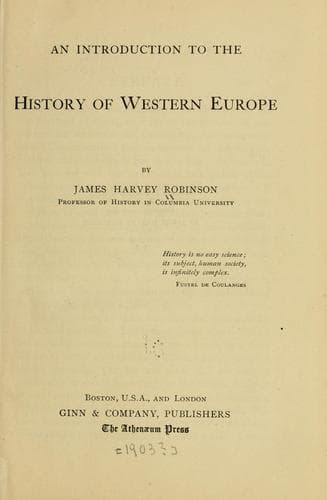
An Introduction to the History of Western EuropeRobinson, James Harvey
History
An Introduction to the History of Western Europe
Robinson, James Harvey
Europe -- History
Of these none was more celebrated than Venice, which in the history of
Europe ranks in importance with Paris and London. This singular town was
built upon a group of sandy islets lying in the Adriatic Sea about two
miles from the mainland. It was protected from the waves by a long,
narrow sand bar, similar to those which fringe the Atlantic coast from
New Jersey southward. Such a situation would not ordinarily have been
deliberately chosen as the site of a great city; but its very desolation
and inaccessibility had recommended it to its first settlers, who, in
the middle of the fifth century, had fled from their homes on the
mainland to escape the savage Huns.[214] As time went on the location
proved to have its advantages commercially, and even before the Crusades
Venice had begun to engage in foreign trade. Its enterprises carried it
eastward, and it early acquired possessions across the Adriatic and in
the Orient.[215] The influence of this intercourse with the East is
plainly shown in the celebrated church of St. Mark, whose domes and
decorations suggest Constantinople rather than Italy.
[Illustration: A Scene in Venice]
[Illustration: St Mark's, Venice]
[Sidenote: Venice extends her sway on the Italian mainland.]
[Sidenote: The aristocratic government of Venice.]
It was not until early in the fifteenth century that Venice found it to
her interest to extend her sway upon the Italian mainland. She doubtless
believed it dangerous to permit her rival, Milan, to get possession of
the Alpine passes through which her goods found their way north. It may
be, too, that she preferred to draw her food supplies from the
neighborhood instead of transporting them across the Adriatic from her
eastern possessions. Moreover, all the Italian cities except Venice
already controlled a larger or smaller area of country about them.
Although Venice was called a republic, there was a strong tendency
toward a government of the few. About the year 1300 all the townsmen
except the members of certain noble families were excluded from the
Grand Council, which was supposed to represent the people at large.
Public-domain text, read in full here on John Shaqi.
Reviews
Reviews
No reviews yet
Be the first to share your thoughts on this work.
Elsewhere in the archive
Join the Discussion
Join the discussion
Sign in to leave a comment or review.
Sign InorCreate an account