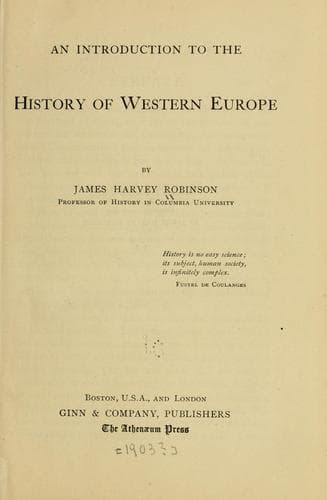
An Introduction to the History of Western EuropeRobinson, James Harvey
History
An Introduction to the History of Western Europe
Robinson, James Harvey
Europe -- History
Toward the end of the fifteenth century the terrible disorder and
uncertainty which resulted from the absence of a strong central
government led to serious efforts upon the part of the _diet_, or
national assembly, to remedy the evils. It was proposed to establish a
court to settle all disputes which should arise among the rulers of the
various states. This was to be held permanently in some convenient
place. The empire was also to be divided into districts, or "circles,"
in each of which a military force was to be organized and maintained to
carry out the law and the decisions of the court. Little was
accomplished, however, for some years, although the diet met more
frequently and regularly, and this gave an opportunity to discuss public
questions. The towns began to send delegates to the diet in 1487, but
the restless knights and some of the other minor nobles had no part in
the deliberations and did not always feel that the decisions of the
assembly were binding upon them. Of the diets which met almost every
year during the Lutheran period in some one of the great German cities,
we shall hear more later.
[Sidenote: Contradiction between Catholic and Protestant writers.]
135. It is natural that Protestant and Catholic writers should differ in
their views of Germany at this period. Among Protestants there has
always been a tendency to see the dark side of affairs, for this exalted
the work of Luther and made him appear the savior of his people. On the
other hand, the Catholic historians have devoted years of research to an
attempt to prove that conditions were, on the whole, happy and serene
and full of hope for the future before Luther and the other
revolutionary leaders brought division and ruin upon the fatherland by
attacking the Church.
[Sidenote: Corresponding contradictions in the conditions in Germany.]
As a matter of fact, the life and thought of Germany during the fifty
years preceding the opening of the Protestant revolt present all sorts
of contradictions and anomalies. The period was one of marked progress.
The people were eager to learn, and they rejoiced in the recent
invention of printing which brought them the new learning from Italy and
hints of another world beyond the seas. Foreigners who visited Germany
were astonished at the prosperity, wealth, and luxury of the rich
merchants, who often spent their money in the encouragement of art and
literature and in the founding of schools and libraries.
Public-domain text, read in full here on John Shaqi.
Reviews
Reviews
No reviews yet
Be the first to share your thoughts on this work.
Elsewhere in the archive
Join the Discussion
Join the discussion
Sign in to leave a comment or review.
Sign InorCreate an account