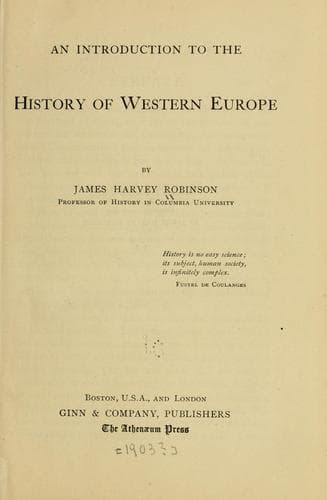
An Introduction to the History of Western EuropeRobinson, James Harvey
History
An Introduction to the History of Western Europe
Robinson, James Harvey
Europe -- History
On the other hand, there was great ill feeling between the various
classes--the petty princes, the townspeople, the knights, and the
peasants. It was generally believed by the other classes that the wealth
of the merchants could only be accounted for by deceit, usury, and sharp
dealing. Never was begging more prevalent, superstition more rife,
vulgarity and coarseness more apparent. Attempts to reform the
government and stop neighborhood war met with little success. Moreover,
the Turks were advancing steadily upon Christendom. The people were
commanded by the pope to send up a prayer each day as the noon bell
rang, that God might deliver them from the on-coming infidel.
Yet we need not be astonished by these contradictions, for history
teaches that all periods of progress are full of them. Any newspaper
will show how true this is to-day: we are, as a nation, good and bad,
rich and poor, peaceful and warlike, learned and ignorant, satisfied and
discontented, civilized and barbarous, all at once.
[Sidenote: Four important characteristics of the time which serve to
explain the Protestant revolt.]
In considering the condition of the Church and of religion in Germany,
four things are particularly important as explaining the origin and
character of the Protestant revolt. First, there was an extraordinary
enthusiasm for all the pomp and ceremony of the old religion, and a
great confidence in pilgrimages, relics, miracles, and all those things
which the Protestants were soon to discard. Secondly, there was a
tendency to read the Bible and to dwell upon the attitude of the sinner
toward God, rather than upon the external acts of religion. Thirdly,
there was a conviction, especially among scholars, that the theologians
had made religion needlessly complicated with their fine-spun logical
distinctions. And lastly, there was the old and very general belief that
the Italian prelates, including the pope, were always inventing new
plans for getting money out of the Germans, whom they regarded as a
stupid people, easily hoodwinked. These four matters we shall consider
in turn.
[Sidenote: Enthusiasm for religious ceremonies and observances.]
136. Never had the many ceremonies and observances of the mediæval
Church attracted more attention or been carried out on a more prodigious
scale than during the latter part of the fifteenth, and the opening
years of the sixteenth century. It seemed as if all Germany agreed to
join in one last celebration of the old religion, unprecedented in
magnificence, before its people parted into two irreconcilable parties.
Great numbers of new churches were erected, and adorned with the richest
productions of German art. Tens of thousands of pilgrims flocked to the
various sacred places, and gorgeous ecclesiastical processions moved
through the streets of the prosperous imperial towns.
[Sidenote: Relics.]
Public-domain text, read in full here on John Shaqi.
Reviews
Reviews
No reviews yet
Be the first to share your thoughts on this work.
Elsewhere in the archive
Join the Discussion
Join the discussion
Sign in to leave a comment or review.
Sign InorCreate an account