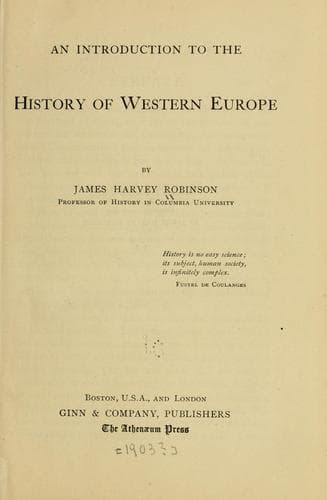
An Introduction to the History of Western EuropeRobinson, James Harvey
History
An Introduction to the History of Western Europe
Robinson, James Harvey
Europe -- History
141. Martin Luther was of peasant origin. His father was very poor, and
was trying his fortune as a miner near the Harz Mountains when his
eldest son, Martin, was born in 1483. Martin sometimes spoke, in later
life, of the poverty and superstition which surrounded him in his
childhood; of how his mother carried on her back the wood for the
household and told him stories of a witch who had made away with the
village priest. The boy was sent early to school, for his father was
determined that his eldest son should be a lawyer. At eighteen, Martin
entered the greatest of the north-German universities, at Erfurt, where
he spent four years. There he became acquainted with some of the young
humanists, for example, the one who is supposed to have written a great
part of the _Letters of Obscure Men_. He was interested in the various
classical writers, but devoted the usual attention to logic and
Aristotle.
[Sidenote: Luther decides to become a monk.]
Suddenly, when he had completed his college course and was ready to
enter the law school, he called his friends together for one last hour
of pleasure, and the next morning he led them to the gate of an
Augustinian monastery, where he bade them farewell and turning his back
on the world became a mendicant friar. That day, July 17, 1505, when the
young master of arts, regardless of his father's anger and
disappointment, sought salvation within the walls of a monastery, was
the beginning of a religious experiment which had momentous consequences
for the world.
[Sidenote: Luther's disappointment in the monastery.]
Luther later declared that "if ever a monk got to heaven through
monkery," he was assuredly among those who merited salvation. So great
was his ardor, so nervously anxious was he to save his soul by the
commonly recognized means of fasts, vigils, prolonged prayers, and a
constant disregard of the usual rules of health, that he soon could no
longer sleep. He fell into despondency, and finally into despair. The
ordinary observance of the rules of the monastery, which satisfied most
of the monks, failed to give him peace. He felt that even if he
outwardly did right he could never purify all his thoughts and desires.
His experience led him to conclude that neither the Church nor the
monastery provided any device which enabled him to keep his affections
always centered on what he knew to be holy and right. Therefore they
seemed to him to fail and to leave him, at heart, a hopelessly corrupt
sinner, justly under God's condemnation.
[Sidenote: Justification by faith, not through 'good works.']
Public-domain text, read in full here on John Shaqi.
Reviews
Reviews
No reviews yet
Be the first to share your thoughts on this work.
Elsewhere in the archive
Join the Discussion
Join the discussion
Sign in to leave a comment or review.
Sign InorCreate an account