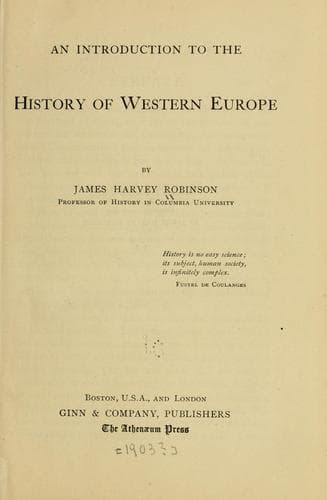
An Introduction to the History of Western EuropeRobinson, James Harvey
History
An Introduction to the History of Western Europe
Robinson, James Harvey
Europe -- History
Gradually a new view of Christianity came to him. The head of the
monastery bade him trust in God's goodness and mercy and not to rely
upon his own "good works." He began to study the writings of St. Paul
and of Augustine, and from them was led to conclude that man was
incapable, in the sight of God, of any good works whatsoever, and could
only be saved by faith in God's promises. This gave him much comfort,
but it took him years to clarify his ideas and to reach the conclusion
that the existing Church was opposed to the idea of justification by
faith, because it fostered what seemed to him a delusive confidence in
"good works." He was thirty-seven years old before he finally became
convinced that it was his duty to become the leader in the destruction
of the old order.
[Sidenote: Luther becomes a teacher in the University of Wittenberg,
1508.]
It was no new thing for a young monk, suddenly cut off from the sunshine
and hoping for speedy spiritual peace, to suffer disappointment and fall
into gloomy forebodings, as did Brother Martin. He, however, having
fought the battle through to victory, was soon placed in a position to
bring comfort to others similarly afflicted with doubts as to their
power to please God. In 1508 he was called to the new university which
Frederick the Wise, elector of Saxony, had established at Wittenberg. We
know little of his early years as a professor, but he soon began to
lecture on the epistles of Paul and to teach his students the doctrine
of justification by faith.
[Illustration: Luther]
[Sidenote: Luther's visit to Rome.]
Luther had as yet no idea of attacking the Church. When, about 1511, he
journeyed to Rome on business of his order, he devoutly visited all the
holy places for the good of his soul, and was almost tempted to wish
that his father and mother were dead, so that he might free them from
purgatory by his pious observances. Yet he was shocked by the impiety of
the Italian churchmen and the scandalous stories about popes Alexander
VI and Julius II, the latter of whom was just then engaged in his
warlike expeditions into northern Italy. The evidences of immorality on
the part of the popes may well have made it easier for him later to
reach the conclusion that the head of the Church was the chief enemy of
religion.
[Sidenote: Luther teaches a new kind of theology.]
Before long he began to encourage his students to defend his favorite
beliefs in the debates in which they took part. For instance, one of the
candidates for a degree, under Luther's inspiration, attacked the old
theology against which the humanists had been fighting. "It is an
error," he says, "to declare that no one can become a theologian without
Aristotle; on the contrary, no one can become a theologian except it be
without him." Luther desired the students to rely upon the Bible,
Paul's writings above all, and upon the church fathers, especially
Augustine.[275]
[Sidenote: Luther's theses on indulgences.]
Public-domain text, read in full here on John Shaqi.
Reviews
Reviews
No reviews yet
Be the first to share your thoughts on this work.
Elsewhere in the archive
Join the Discussion
Join the discussion
Sign in to leave a comment or review.
Sign InorCreate an account