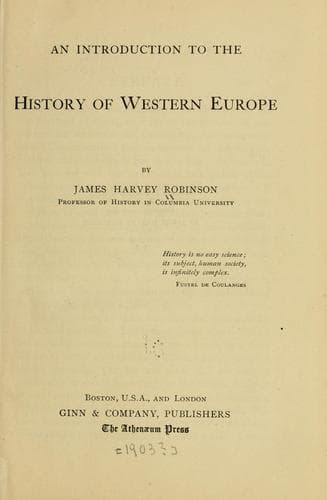
An Introduction to the History of Western EuropeRobinson, James Harvey
History
An Introduction to the History of Western Europe
Robinson, James Harvey
Europe -- History
Theodoric's distinguished Roman counselor, Cassiodorus (d. 575), to
whose letters we owe a great part of our knowledge of the period, busied
himself in his old age in preparing text-books of the liberal arts and
sciences,--grammar, arithmetic, logic, geometry, rhetoric, music, and
astronomy. His manuals were intended to give the uninstructed priests a
sufficient preparation for the study of the Bible and of the doctrines
of the Church. His absurdly inadequate and, to us, silly treatment of
these seven important subjects, to which he devotes a few pages each,
enables us to estimate the low plane to which learning had fallen in
Italy in the sixth century. Yet his books were regarded as standard
treatises in these great fields of knowledge all through the Middle
Ages. So mediæval Europe owed these, and other text-books upon which she
was dependent for her knowledge, to the period when Latin culture was
coming to an end.
[Sidenote: Scarcely any writers in western Europe during the sixth,
seventh, and eighth centuries.]
A long period of gloom now begins. Between the time of Theodoric and
that of Charlemagne three hundred years elapsed, during which scarcely a
writer was to be found who could compose, even in the worst of Latin, a
chronicle of the events of his day.[15] Everything conspired to
discourage education. The great centers of learning--Carthage, Rome,
Alexandria, Milan--were partially destroyed by the barbarians or the
Arabs. The libraries which had been kept in the temples of the gods were
often annihilated, along with the pagan shrines, by Christian
enthusiasts, who were not sorry to see the heathen literature disappear
with the heathen religion. Shortly after Theodoric's death the eastern
emperor withdrew the support which the government had hitherto granted
to public teachers and closed the great school at Athens. The only
important historian of the sixth century was the half-illiterate
Gregory, Bishop of Tours (d. 594), whose whole work is unimpeachable
evidence of the sad state of intellectual affairs. He at least heartily
appreciated his own ignorance and exclaims, in incorrect Latin, "Woe to
our time, for the study of letters has perished from among us."
[Sidenote: Justinian destroys the kingdoms of the Vandals and the East
Goths.]
Public-domain text, read in full here on John Shaqi.
Reviews
Reviews
No reviews yet
Be the first to share your thoughts on this work.
Join the Discussion
Join the discussion
Sign in to leave a comment or review.
Sign InorCreate an account