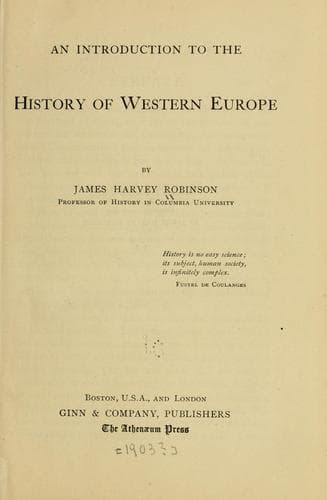
An Introduction to the History of Western EuropeRobinson, James Harvey
History
An Introduction to the History of Western Europe
Robinson, James Harvey
Europe -- History
The bull irritated the German princes; whether they liked Luther or not,
they decidedly disliked to have the pope issuing commands to them. Then
it appeared to them very unfair that Luther's personal enemy should have
been intrusted with the publication of the bull. Even the princes and
universities that were most friendly to the pope published the bull with
great reluctance. The students of Erfurt and Leipsic pursued Eck with
pointed allusions to Pharisees and devil's emissaries. In many cases the
bull was ignored altogether. Luther's own sovereign, the elector of
Saxony, while no convert to the new views, was anxious that Luther's
case should be fairly considered, and continued to protect him. One
mighty prince, however, the young emperor Charles V, promptly and
willingly published the bull; not, however, as emperor, but as ruler of
the Austrian dominions and of the Netherlands. Luther's works were
burned at Louvain, Mayence, and Cologne, the strongholds of the old
theology.
[Sidenote: Luther defies pope and emperor.]
"Hard it is," Luther exclaimed, "to be forced to contradict all the
prelates and princes, but there is no other way to escape hell and
God's anger." Never had one man so unreservedly declared war upon pretty
much the whole consecrated order of things. As one power arrayed against
an equal, the Wittenberg professor opposed himself to pope and emperor,
giving back curse for curse and fagot for fagot. His students were
summoned to witness "the pious, religious spectacle," when he cast Leo's
bull on the fire, along with the canon law and one of the books of
scholastic theology which he most disliked.
[Sidenote: Hutten's plan for an immediate destruction of the old
Church.]
Never was the temptation so great for Luther to encourage a violent
demolition of the old structure of the Church as at this time. Hutten
was bent upon the speedy carrying out of the revolution which both he
and Luther were forwarding by their powerful writings. Hutten had taken
refuge in the castle of the leader of the German knights, Franz von
Sickingen, who he believed would be an admirable military commander in
the coming contest for truth and liberty. Hutten frankly proposed to the
young emperor that the papacy should be abolished, that the property of
the Church should be confiscated, and that ninety-nine out of a hundred
of the clergy should be dispensed with as superfluous. In this way
Germany would be freed, he argued, from the control of the "parsons" and
from their corruption. From the vast proceeds of the confiscation the
state might be strengthened and an army of knights might be maintained
for the defense of the empire.
[Sidenote: Views of the papal representative on public opinion in
Germany.]
Public-domain text, read in full here on John Shaqi.
Reviews
Reviews
No reviews yet
Be the first to share your thoughts on this work.
Elsewhere in the archive
Join the Discussion
Join the discussion
Sign in to leave a comment or review.
Sign InorCreate an account