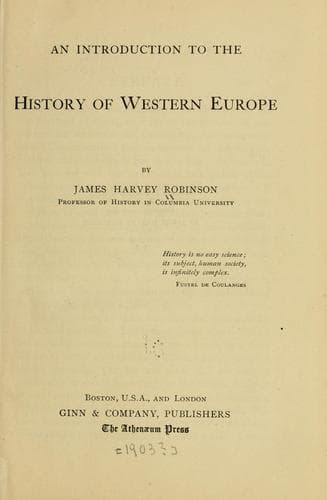
An Introduction to the History of Western EuropeRobinson, James Harvey
History
An Introduction to the History of Western Europe
Robinson, James Harvey
Europe -- History
Public opinion appeared ready for a revolution. "I am pretty familiar
with the history of this German nation," Leo's representative, Aleander,
remarked; "I know their past heresies, councils, and schisms, but never
were affairs so serious before. Compared with present conditions, the
struggle between Henry IV and Gregory VII was as violets and roses....
These mad dogs are now well equipped with knowledge and arms; they boast
that they are no longer ignorant brutes like their predecessors; they
claim that Italy has lost the monopoly of the sciences and that the
Tiber now flows into the Rhine." "Nine-tenths of the Germans," he
calculated, "are shouting 'Luther,' and the other tenth goes so far at
least as 'Death to the Roman curia.'"
[Sidenote: Luther's attitude toward a violent realization of his
reforms.]
Luther was too frequently reckless and violent in his writings. He often
said that bloodshed could not be avoided when it should please God to
visit his judgments upon the stiff-necked and perverse generation of
"Romanists," as the Germans contemptuously called the supporters of the
pope. Yet he always discouraged precipitate reform. He was reluctant to
make changes, except in belief. He held that so long as an institution
did not mislead, it did no harm. He was, in short, no fanatic at heart.
The pope had established himself without force, so would he be crushed
by God's word without force. This, we may assume, was Luther's most
profound conviction, even in the first period of enthusiasm and
confidence. He perhaps never fully realized how different Hutten's ideas
were from his own, for the poet knight died while still a young man. And
as for Franz von Sickingen, Luther soon learned to execrate the
ruthless, worldly soldier who brought discredit by his violence upon the
cause of reform.
[Sidenote: Charles V's want of sympathy with the German reformers.]
147. Among the enemies of the German reformers none was more important
than the young emperor. It was toward the end of the year 1520 that
Charles came to Germany for the first time. After being crowned king of
the Romans at Aix-la-Chapelle, he assumed, with the pope's consent, the
title of emperor elect, as his grandfather Maximilian had done. He then
moved on to the town of Worms, where he was to hold his first diet and
face the German situation.
Public-domain text, read in full here on John Shaqi.
Reviews
Reviews
No reviews yet
Be the first to share your thoughts on this work.
Elsewhere in the archive
Join the Discussion
Join the discussion
Sign in to leave a comment or review.
Sign InorCreate an account