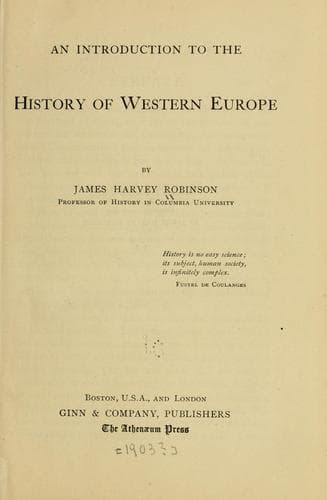
An Introduction to the History of Western Europe — John Shaqi
An Introduction to the History of Western EuropeRobinson, James Harvey
History
An Introduction to the History of Western Europe
Robinson, James Harvey
Europe -- History
The German laws did not provide for the trial, either in the Roman or
the modern sense of the word, of a suspected person. There was no
attempt to gather and weigh evidence and base the decision upon it. Such
a mode of procedure was far too elaborate for the simple-minded Germans.
Instead of a regular trial, one of the parties to the case was
designated to prove that his assertions were true by one of the
following methods: (1) He might solemnly swear that he was telling the
truth and get as many other persons of his own class as the court
required, to swear that they believed that he was telling the truth.
This was called _compurgation_. It was believed that the divine
vengeance would be visited upon those who swore falsely. (2) On the
other hand, the parties to the case, or persons representing them, might
meet in combat, on the supposition that Heaven would grant victory to
the right. This was the so-called _wager of battle_. (3) Lastly, one or
other of the parties might be required to submit to the _ordeal_ in one
of its various forms: He might plunge his arm into hot water, or carry a
bit of hot iron for some distance, and if at the end of three days he
showed no ill effects, the case was decided in his favor. He might be
ordered to walk over hot plowshares, and if he was not burned, it was
assumed that God had intervened by a miracle to establish the
right.[23] This method of trial is but one example of the rude
civilization which displaced the refined and elaborate organization of
the Romans.
[Sidenote: The task of the Middle Ages.]
16. The account which has been given of the conditions in the Roman
Empire, and of the manner in which the barbarians occupied its western
part, makes clear the great problem of the Middle Ages. The Germans, no
doubt, varied a good deal in their habits and spirit. The Goths differed
from the Lombards, and the Franks from the Vandals; but they all agreed
in knowing nothing of the art, literature, and science which had been
developed by the Greeks and adopted by the Romans. The invaders were
ignorant, simple, vigorous people, with no taste for anything except
fighting and bodily comfort. Such was the disorder that their coming
produced, that the declining civilization of the Empire was pretty
nearly submerged. The libraries, buildings, and works of art were
destroyed and there was no one to see that they were restored. So the
western world fell back into a condition similar to that in which it had
been before the Romans conquered and civilized it.[24]
Public-domain text, read in full here on John Shaqi.
Reviews
Reviews
No reviews yet
Be the first to share your thoughts on this work.
Join the Discussion
Join the discussion
Sign in to leave a comment or review.
Sign InorCreate an account