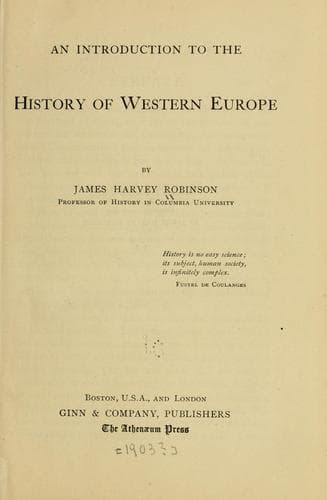
An Introduction to the History of Western EuropeRobinson, James Harvey
History
An Introduction to the History of Western Europe
Robinson, James Harvey
Europe -- History
We have already seen how marvelously the Christian communities founded
by the apostles and their fellow-missionaries multiplied until, by the
middle of the third century, writers like Cyprian came to conceive of a
"Catholic," or all-embracing, Church. We have seen how Constantine first
made Christianity legal, and how his successors worked in the interest
of the new religion; how carefully the Theodosian Code safeguarded the
Church and the Christian clergy, and how harshly those were treated who
ventured to hold another view of Christianity from that sanctioned by
the government.[25]
We must now follow this most powerful and permanent of all the
institutions of the later Roman Empire into the Middle Ages. We must
stop a moment to consider the sources of its power, and then see how the
Western, or Latin, portion of Christendom fell apart from the Eastern,
or Greek, region and came to form a separate institution under the
longest and mightiest line of rulers that the world has ever seen, the
Roman bishops. We shall see how a peculiar class of Christians, the
monks, developed; how they joined hands with the clergy; how the monks
and the clergy met the barbarians, subdued and civilized them, and then
ruled them for centuries.
[Sidenote: Sources of the Church's power.]
The tremendous power of the Church in the Middle Ages was due, we may be
sure, to the way in which it adapted itself to the ideas and needs of
the time; for no institution can flourish unless it meets the wants of
those who live under it.
[Sidenote: Contrast between pagan and Christian ideas.]
One great source of the Church's strength lay in the general fear of
death and judgment to come, which Christianity had brought with it. The
Greeks and Romans of the classical period thought of the next life, when
they thought of it at all, as a very uninteresting existence compared
with that on this earth. One who committed some signal crime might
suffer for it after death with pains similar to those of the hell in
which the Christians believed. But the great part of humanity were
supposed to lead in the next world a shadowy existence, neither sad nor
glad. Religion, even to the devout pagan, was mainly an affair of this
life; the gods were to be propitiated with a view to present happiness
and success.
Since no satisfaction could be expected in the next life, it was
naturally deemed wise to make the most of this one. The possibility of
pleasure ends--so the poet Horace urges--when we join the shades below,
as we all must do soon. Let us, therefore, take advantage of every
harmless pleasure and improve our brief opportunity to enjoy the good
things of earth. We should, however, be reasonable and temperate,
avoiding all excess, for that endangers happiness. Above all, we should
not worry uselessly about the future, which is in the hands of the gods
and beyond our control. Such were the convictions of the majority of
thoughtful pagans.
Public-domain text, read in full here on John Shaqi.
Reviews
Reviews
No reviews yet
Be the first to share your thoughts on this work.
Join the Discussion
Join the discussion
Sign in to leave a comment or review.
Sign InorCreate an account