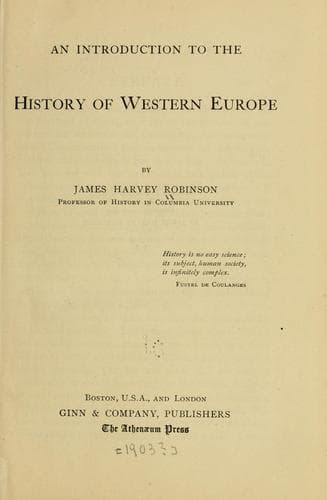
An Introduction to the History of Western EuropeRobinson, James Harvey
History
An Introduction to the History of Western Europe
Robinson, James Harvey
Europe -- History
Gregory enjoyed an unrivaled reputation during the Middle Ages as a
writer. He is reckoned with Augustine, Ambrose, and Jerome as one of the
four great Latin "fathers" of the Church. His works show, however, how
much less cultivated his period was than that of his predecessors. His
most popular book was his _Dialogues_, a collection of accounts of
miracles and popular legends. It is hard to believe that it could have
been composed by the greatest man of the time and that it was designed
for adults. In his commentary on Job, Gregory warns the reader that he
need not be surprised to find mistakes in grammar, since in dealing with
so high a theme a writer should not stop to make sure whether his cases
and tenses are right.[30]
[Illustration: The Castle San Angelo, formerly the Tomb of the Emperor
Hadrian]
[Sidenote: Gregory as a statesman.]
Gregory's letters show clearly what the papacy was coming to mean for
Europe when in the hands of a really great man. While he assumed the
humble title of "Servant of the servants of God," which the popes still
use, Gregory was a statesman whose influence extended far and wide. It
devolved upon him to govern the city of Rome,--as it did upon his
successors down to the year 1870,--for the eastern emperor's control had
become merely nominal. He had also to keep the Lombards out of central
Italy, which they failed to conquer largely on account of the valiant
defense of the popes. These duties were functions of the civil power,
and in assuming them Gregory may be said to have founded the temporal
power of the popes.
[Sidenote: Gregory's missionary undertakings.]
Beyond the borders of Italy, Gregory was in constant communication with
the emperor, with the rulers of Austrasia, Neustria, and Burgundy.
Everywhere he used his influence to have good clergymen chosen as
bishops, and everywhere he watched over the interests of the
monasteries. But his chief importance in the history of the papacy is
attributable to the missionary enterprises which he undertook, through
which the great countries which were one day to be called England,
France, and Germany were brought under the sway of the Roman Church and
its head, the pope.
Gregory was, as we have seen, an enthusiastic monk, and he naturally
relied chiefly upon the monks in his great work of converting the
heathen. Consequently, before considering his missionary achievements,
we must glance at the origin and character of the monks, who are so
conspicuous throughout the Middle Ages.
Public-domain text, read in full here on John Shaqi.
Reviews
Reviews
No reviews yet
Be the first to share your thoughts on this work.
Join the Discussion
Join the discussion
Sign in to leave a comment or review.
Sign InorCreate an account